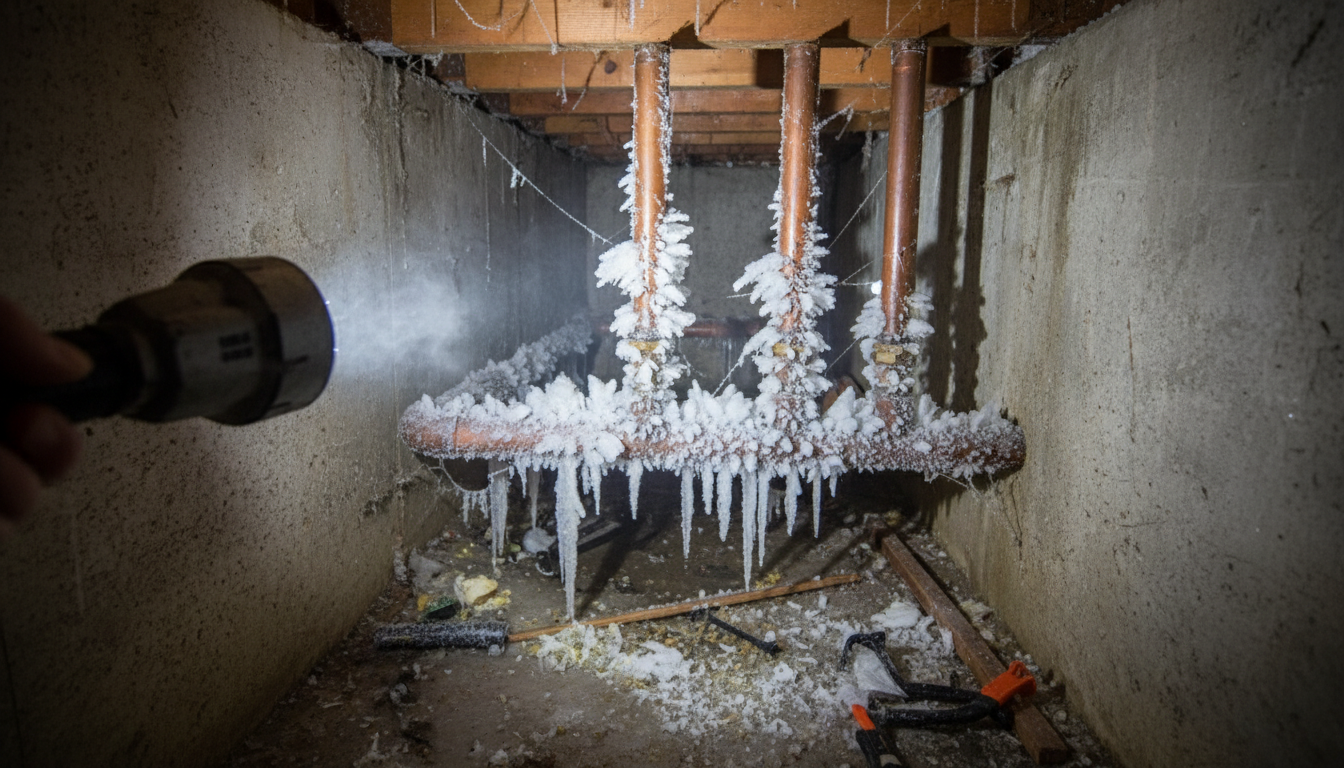
Frozen pipes in a North Bay crawl space — a common sight when temperatures plunge below -30°C.
When temperatures in North Bay drop to -30°C or colder — which happens every winter — unprotected water pipes can freeze in as little as 6 hours. Here's how to prevent it, what to watch for, and what to do if it happens.
Every winter, North Bay homeowners deal with frozen pipes. It's one of the most common — and most expensive — plumbing emergencies in the Nipissing District. A single burst pipe from a freeze can cause $5,000 to $25,000 in water damage. The good news: frozen pipes are almost entirely preventable with the right preparation.
This guide covers everything you need to know to protect your home, whether you live in a 1960s bungalow in West Ferris or a lakefront property on Trout Lake.
Why North Bay Homes Are Especially Vulnerable
North Bay isn't Southern Ontario. Our winters are longer, colder, and more punishing on residential plumbing than most Canadians experience. Here's what makes frozen pipes such a persistent problem in our region.
Extreme cold is the norm, not the exception. Environment Canada data shows North Bay averages 35+ days below -20°C each winter, with cold snaps regularly pushing temperatures to -30°C and wind chills to -40°C. The frost line in the North Bay area extends 4 to 5 feet deep — significantly deeper than cities like Toronto or Ottawa. Any pipe that's above the frost line and lacks insulation is at risk.
Older homes in West Ferris and Downtown weren't built for modern insulation standards. Homes constructed in the 1950s through 1970s — which make up a large portion of West Ferris, downtown North Bay, and the south end — often have plumbing routed through exterior walls or running through uninsulated crawl spaces. These building practices were common at the time but create serious freeze risks by today's standards. These older homes account for the majority of our frozen pipe repair calls each winter.
Lake Nipissing waterfront properties in Callander face unique exposure. Waterfront homes and cottages along Lake Nipissing and in Callander often have exposed foundations and crawl spaces that are particularly vulnerable to wind-driven cold. The combination of open lake exposure and older construction means these properties need extra protection.
Rural properties have long, vulnerable supply line runs. If you're in Corbeil, Bonfield, or out by Trout Lake on a well water system, you may have 50 to 100+ feet of supply line between your well and your home. That's a lot of pipe to protect. Well pumps and pressure tanks in unheated outbuildings or crawl spaces are also common freeze points on rural properties in the North Bay area.
The 7 Most Vulnerable Spots in Your Home
Not all pipes freeze equally. These are the seven locations where frozen pipes happen most often in North Bay homes, ranked by frequency from our service calls.
- Pipes in exterior walls — Especially on north-facing walls. If your kitchen or bathroom sink is on an outside wall, the supply lines running through that wall cavity are exposed to the coldest temperatures in your home.
- Crawl spaces and unheated basements — Crawl spaces are the #1 freeze location in North Bay. Many are vented to the outside (which was once considered best practice) and offer zero insulation protection for pipes running through them.
- Garage supply lines — If you have a sink, utility tub, or water heater in your garage, those supply lines are at serious risk. Most garages in North Bay are unheated and barely insulated.
- Outdoor hose bibs and faucets — Any exterior faucet that hasn't been properly shut off and drained before winter is a guaranteed freeze. The ice can travel back into the supply line inside your home.
- Kitchen sink pipes on exterior walls — This is a specific subset of #1, but it's so common it deserves its own mention. The cabinet doors trap cold air against the exterior wall, making the pipe even colder.
- Pipes near rim joists — The rim joist (where the floor framing meets the foundation) is one of the least insulated areas in most North Bay homes. Pipes running near rim joists are exposed to outside temperatures through gaps and poor insulation.
- Well water supply lines — Rural properties around Corbeil, Bonfield, and Trout Lake with well water systems often have long underground supply runs. If the supply line isn't buried below the frost line (4–5 feet in our area), it will freeze.
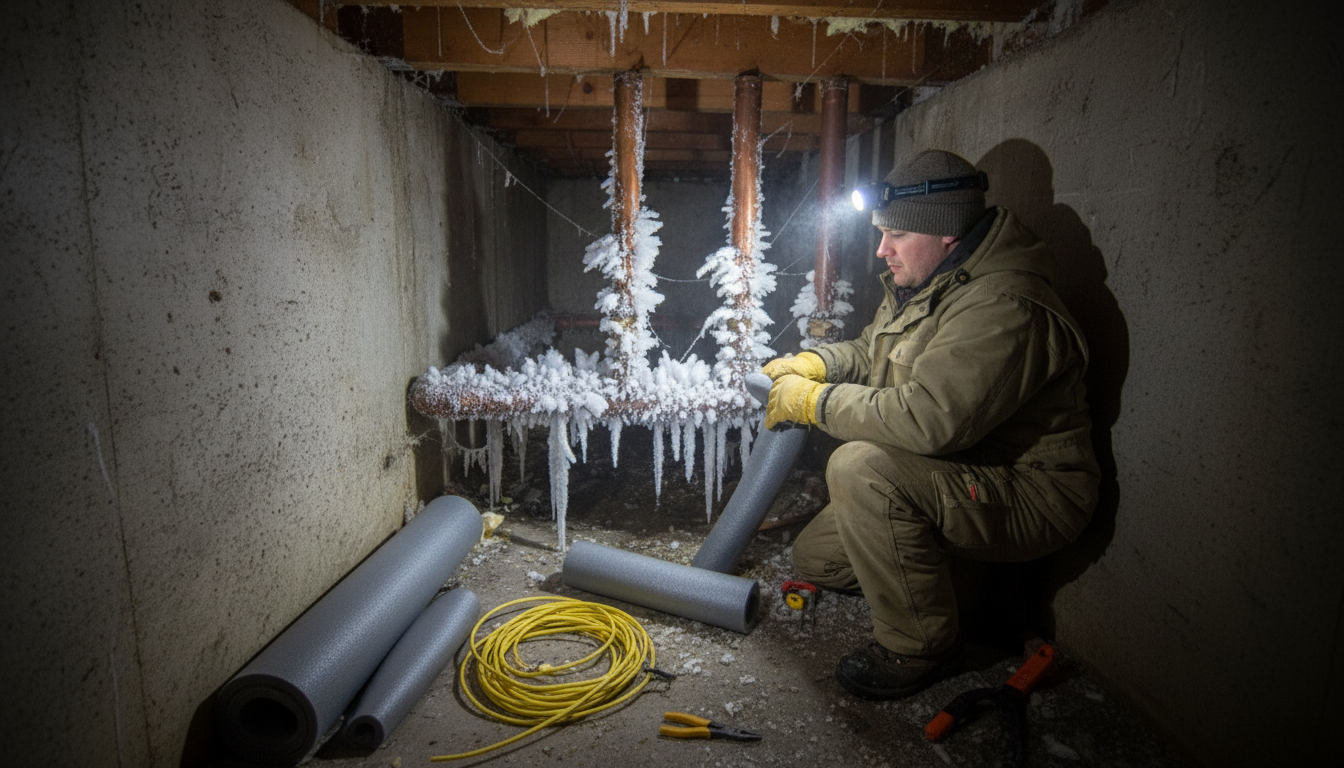
Installing foam pipe insulation on exposed basement plumbing — one of the most cost-effective freeze prevention measures.
How to Protect Your Pipes Before Winter
The best time to prevent frozen pipes is before the first hard freeze in November. Here's your complete prevention checklist, roughly in order of priority and impact.
Insulate all exposed pipes. Foam pipe sleeves are cheap (under $2 per 6-foot section at Home Hardware or Home Depot in North Bay) and easy to install. Cover every exposed pipe in your basement, crawl space, and garage. For pipes in crawl spaces that see the worst cold, double up with fibreglass wrap over foam sleeves. Insulation doesn't stop a freeze forever — it slows heat loss to buy you time during extreme cold snaps.
Install heat cables on vulnerable pipe runs. For pipes that freeze repeatedly — crawl spaces, exterior walls, garage supply lines — heat cables are the most reliable solution. We'll cover heat cables in detail in the next section.
Seal air leaks near pipes. Cold air infiltration is the #1 accelerator of frozen pipes. Check around rim joists, foundation cracks, and where pipes penetrate exterior walls. Seal gaps with spray foam or caulk. A small draft of -30°C air blowing directly on a pipe will freeze it far faster than still cold air.
Disconnect and drain outdoor hoses. This is the easiest and most forgotten prevention step. Before the first freeze, disconnect all garden hoses, close the interior shutoff valve for each hose bib, and open the exterior faucet to drain any remaining water. If you don't have interior shutoff valves for your hose bibs, a plumber can install frost-proof hose bibs for $150–$250 each.
Know where your main water shutoff is. If a pipe does freeze and burst, your ability to shut off the water supply in seconds rather than minutes can mean the difference between a wet floor and a destroyed basement. Find your main shutoff valve now — don't wait for an emergency. It's typically near your water meter, in the basement or mechanical room. Make sure it turns smoothly. If it's seized, have a plumber service it before winter.
Keep cabinet doors open during extreme cold snaps. When Environment Canada issues an extreme cold warning (which happens multiple times each winter in North Bay), open the cabinet doors under any sink on an exterior wall. This lets warm air from the room circulate around the pipes. It sounds simple because it is — and it works.
Maintain a minimum 13°C (55°F) in all areas with plumbing. Never let any room with plumbing drop below 13°C, even if it's an unused guest room or finished basement. If you're leaving town during winter, keep the thermostat set to at least 13°C. If you're winterizing a cottage or seasonal property, drain the entire plumbing system instead — we offer full winterization services for seasonal properties.
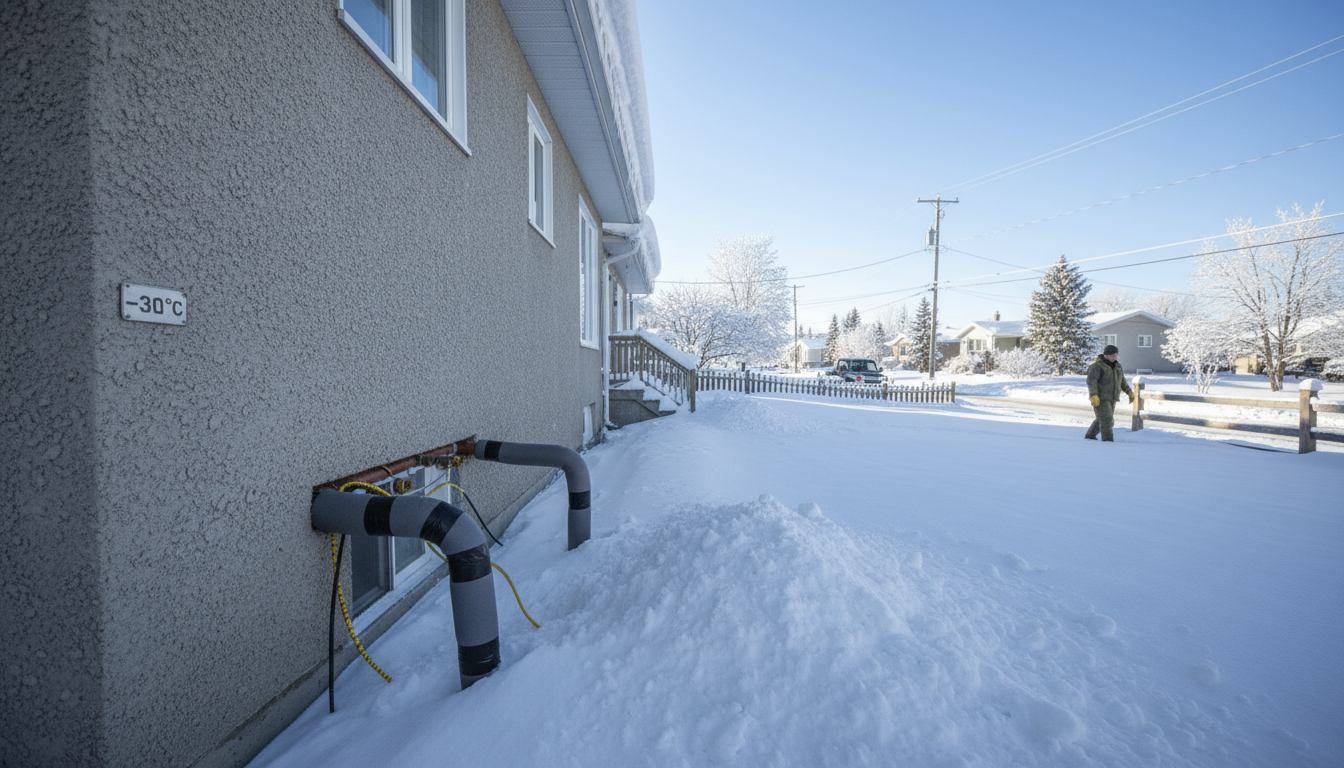
Properly insulated pipe entry points at the exterior wall — a critical detail often overlooked during construction.
Heat Cables — Your Best Defence Against -40°C
If you've had pipes freeze in the same spot more than once, or if you have pipes in locations where insulation alone isn't enough, heat cables are the answer. They're the single most effective tool for preventing frozen pipes in Northern Ontario's extreme winters.
What They Are and How They Work
Heat cables (also called heat trace or heat tape) are electrical cables that produce low-level heat along their length. You install them directly along the pipe, and they keep the pipe temperature above freezing even when the surrounding air drops to -40°C or colder.
Self-Regulating vs Constant-Wattage
There are two types of heat cables. Self-regulating cables automatically increase heat output as the temperature drops and reduce it as conditions warm up. They're more expensive upfront but use less electricity and can't overheat. Constant-wattage cables produce the same heat regardless of temperature and must be used with a thermostat to prevent wasted energy. For most North Bay homes, we recommend self-regulating cables — they're safer and more energy-efficient over a full winter season.
Where and How to Install Them
Heat cables run along the pipe in a straight line — not wrapped in a spiral (a common DIY mistake). They're secured with cable ties or aluminium tape, then covered with pipe insulation to hold the heat in. Typical installation points include crawl space pipes, exterior wall cavities, garage supply lines, and well water supply lines on rural properties.
Cost and Efficiency
Professional heat cable installation typically costs $150–$400 depending on the length of pipe and accessibility. Self-regulating cables use minimal electricity — typically $5–$15 per month during winter — and only activate when the temperature near the pipe drops close to freezing. Compare that to the $5,000+ cost of a single burst pipe repair plus water damage, and heat cables pay for themselves the first winter.
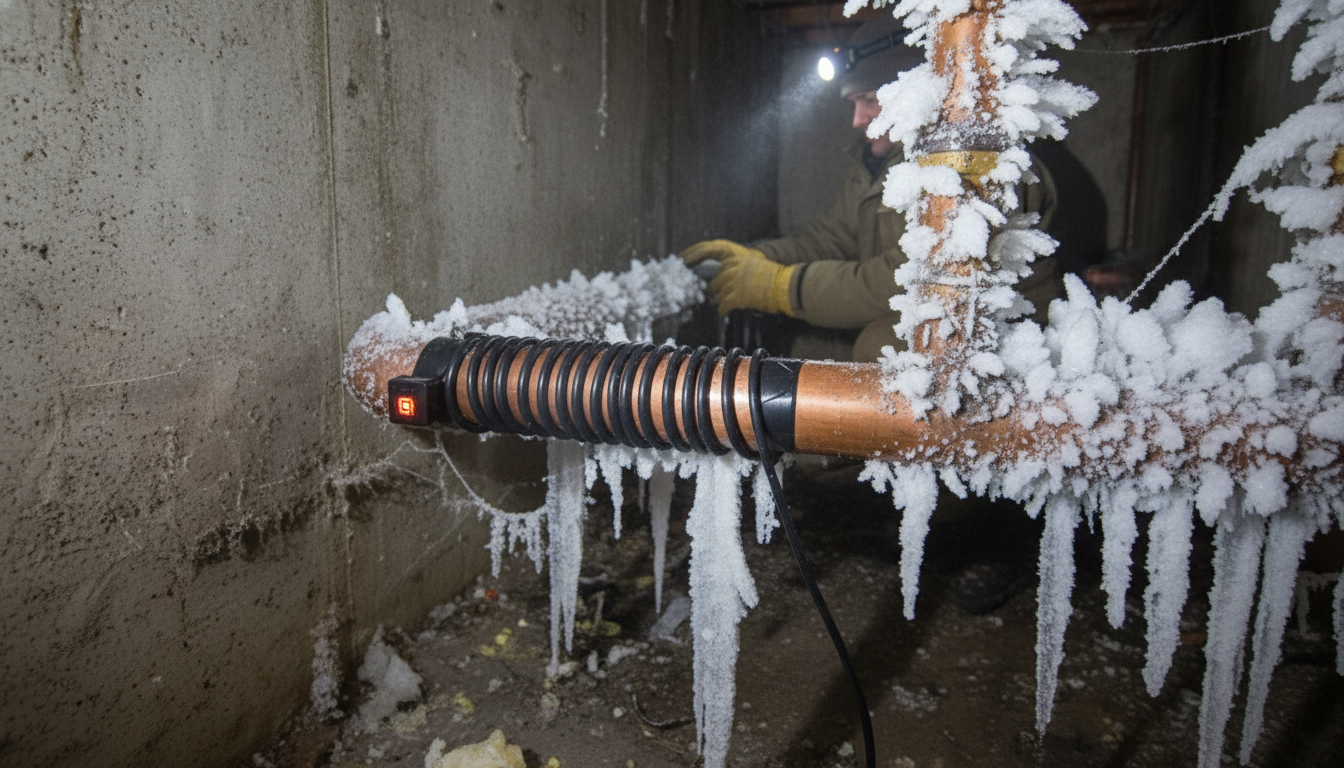
Self-regulating heat cable installed on a copper supply line — note the frost line where the cable protection ends.
What to Do If Your Pipes Freeze
If Your Pipes Are Already Frozen — Do This Now
- Do NOT use a torch or open flame. This is the most dangerous mistake homeowners make. Blowtorches cause house fires and can damage pipes through thermal shock. Never use open flame on or near plumbing.
- Open the faucet to relieve pressure. Turn on both the hot and cold handles of the affected faucet. This gives melting water a place to go and relieves the dangerous pressure buildup that causes burst pipes.
- Apply gentle heat. Use a hair dryer, portable space heater (kept away from anything flammable), warm towels, or a heat lamp. Start from the faucet end and work back toward the frozen section so melting water can flow out.
- Check for splits or bulges. While applying heat, watch the pipe carefully. If you see the pipe bulging, cracking, or any signs of deformation, stop and call a plumber. The pipe has likely already failed and will leak when it thaws.
- Call a plumber if you can't locate the freeze or if the pipe has burst. If you can't find where the freeze is, if multiple fixtures are affected, or if you see any pipe damage, call 705-482-1253 for emergency frozen pipe repair.
Time matters. A frozen pipe can burst at any moment. The longer you wait, the higher the risk of catastrophic water damage.
If you manage to thaw the pipe yourself without any visible damage, you should still have a plumber inspect it. Ice expansion can cause micro-cracks and weakened joints that won't leak immediately but may fail later in the winter. Our leak detection service can identify hidden damage before it becomes a problem.
When to Call a Professional
Some frozen pipe situations are DIY-manageable. Others need a licensed plumber immediately. Call a professional if:
- You can't locate the frozen section. If the freeze is inside a wall, under a slab, or in an inaccessible crawl space, you need professional thawing equipment. Guessing and applying heat in the wrong location wastes critical time.
- Multiple fixtures are affected. If more than one faucet has stopped flowing, the freeze is likely on a main supply line — not a branch line. Main line freezes require professional equipment and expertise to thaw safely.
- You see bulging, cracking, or frost on the pipe. These are signs of severe freeze damage. The pipe may already have failed. A plumber can thaw it under controlled conditions and repair the damage immediately.
- You smell gas near the freeze. If frozen gas lines are involved, evacuate immediately and call your gas utility. Do not attempt to thaw gas lines yourself under any circumstances.
- The pipe has already burst. Shut off the main water supply, then call for emergency burst pipe repair. The faster you get the water off and a plumber on site, the less water damage you'll sustain.
For any plumbing emergency — frozen pipes, burst pipes, flooding — our 24/7 emergency line is 705-482-1253. We respond within 60 minutes across North Bay, Callander, and surrounding areas.
Need Help With Frozen Pipes?
Whether you need emergency thawing right now, winterization before the next cold snap, or a long-term prevention plan, we're here to help. One call gets it handled.
Call 705-482-1253