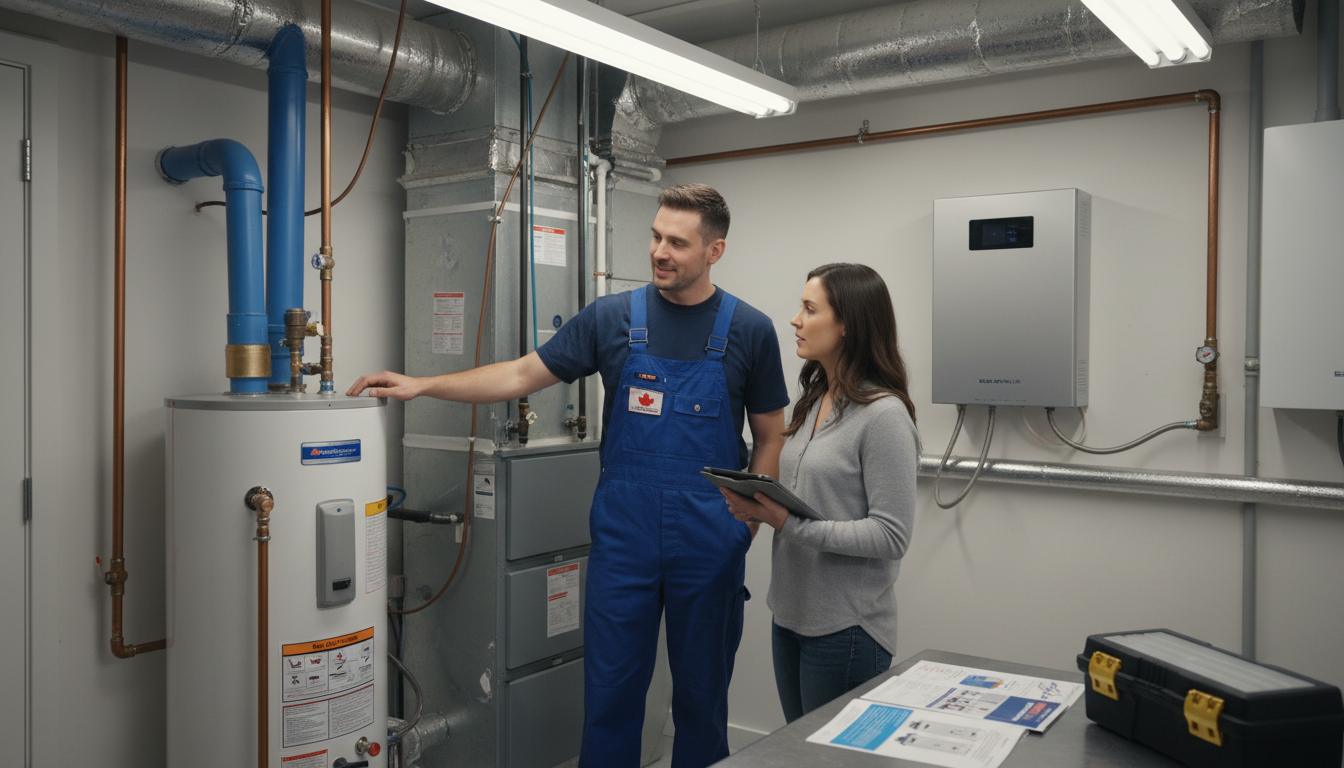
A licensed plumber walking a North Bay homeowner through their water heater options — the right choice depends on your household, your budget, and your home's infrastructure.
The average water heater lasts 8–12 years. If yours is approaching that range, here's everything you need to know about choosing a replacement — from tank vs tankless trade-offs to sizing, efficiency ratings, costs, and whether renting or buying makes more sense in Ontario.
Replacing a water heater isn't something most homeowners think about until they're standing in a cold shower or staring at a puddle in the basement. But if your unit is 8+ years old, now is the time to start planning — before an emergency forces a rushed decision.
This guide covers everything Ontario homeowners need to know, with specific considerations for Northern Ontario's climate. Because what works in Toronto doesn't always work when your incoming water temperature is barely above freezing for five months of the year.
Tank vs Tankless — The Real Comparison
This is the first decision most homeowners face, and there's a lot of marketing noise around it. Here's an honest breakdown of both options, specifically for homes in the North Bay area.
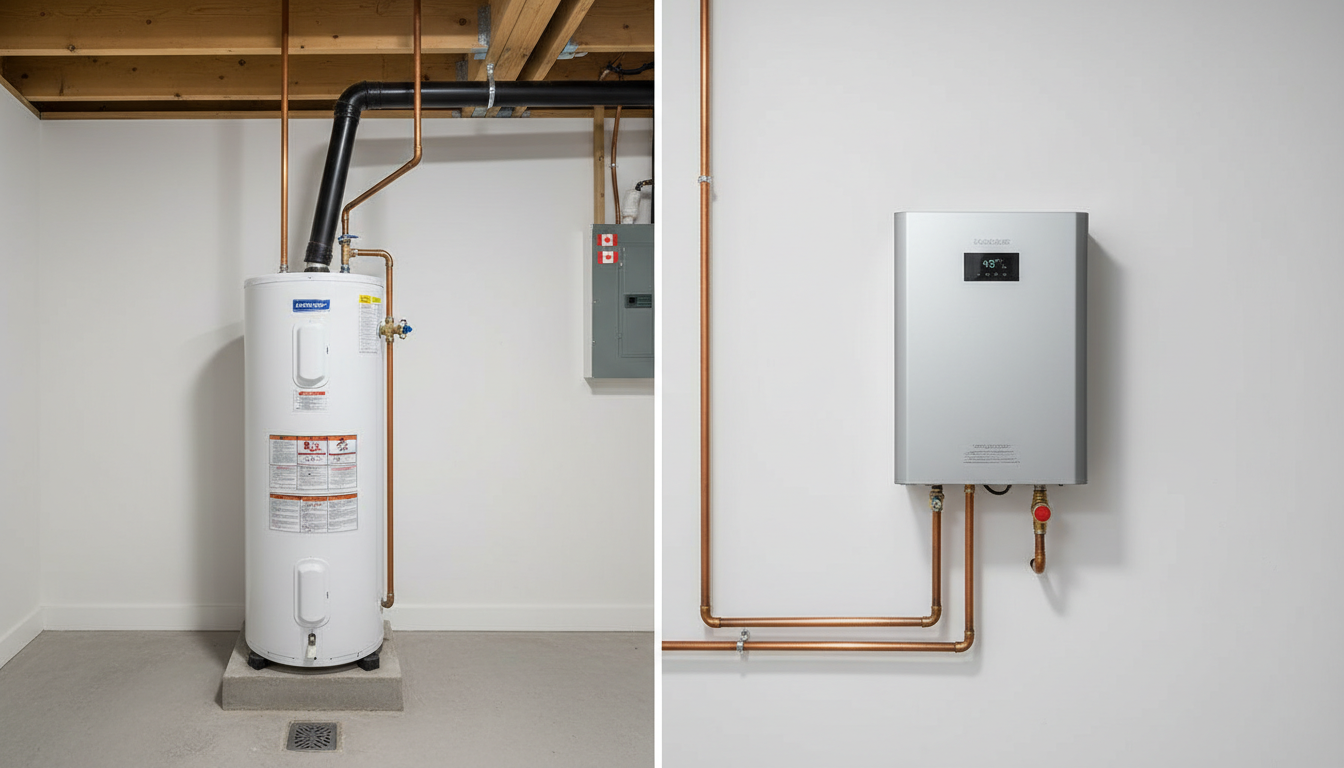
Tank and tankless water heaters side by side — each has real advantages depending on your situation.
Tank Water Heaters
Tank water heaters store 40–60 gallons of hot water in an insulated tank, keeping it ready at all times. They've been the standard in Canadian homes for decades, and for good reason.
- Lower upfront cost. A quality tank water heater installed typically runs $1,500–$3,000 in North Bay, depending on capacity and efficiency rating.
- Simple, proven technology. Fewer components mean fewer things that can go wrong. Most plumbers can service a tank unit quickly and affordably.
- Reliable in extreme cold. Tank units aren't affected by incoming water temperature the way tankless units are. When it's −30°C outside and your incoming water is 2–4°C, a tank unit doesn't care — it's already heated and stored.
- Works during power outages (gas models). A gas tank water heater with a standing pilot light will continue to deliver hot water during a power outage — a real advantage during North Bay's winter storms.
- Standby energy loss. The main downside. Tank units constantly use energy to keep stored water hot, even when nobody's using it. Modern insulated tanks have reduced this significantly, but it's still a factor.
- Limited supply. Once the tank is empty, you're waiting 30–60 minutes for it to reheat. Large families running back-to-back showers will notice this.
Tankless Water Heaters
Tankless (on-demand) units heat water only when you turn on a faucet. They're compact, energy-efficient, and increasingly popular — but they come with important caveats for Northern Ontario homeowners.
- Unlimited hot water. No tank to empty. As long as a faucet is running, you get hot water. Great for large families or homes with high demand.
- Energy savings. No standby heat loss means 15–30% lower energy costs compared to a conventional tank unit. Over a 15–20 year lifespan, that adds up.
- Longer lifespan. Tankless units typically last 15–20 years vs 8–12 for tank models. With proper maintenance, some last 25+ years.
- Space savings. Wall-mounted units free up significant floor space — useful in smaller mechanical rooms or condos.
- Higher upfront cost. Installed cost runs $3,500–$6,000 in North Bay. If you're switching from tank to tankless, additional costs for gas line upgrades, venting changes, and electrical work can push the total higher.
- The cold-climate reality. This is the big one for Northern Ontario. Tankless units are rated by how many degrees they can raise water temperature at a given flow rate. When incoming water is 2–4°C (common from November through April in North Bay), the unit has to work much harder to reach 49°C at the tap. A unit rated at 7.5 GPM in Phoenix might only deliver 3–4 GPM in North Bay during winter. That means running two showers simultaneously might drop the temperature noticeably.
Our Honest Take for Northern Ontario
For most North Bay homes, a high-efficiency tank water heater is still the most practical choice. Tank units deliver consistent performance regardless of incoming water temperature, cost significantly less to install, and are simpler to maintain.
Tankless makes sense if you have a larger home with high demand, if you're building new (avoiding retrofit costs), or if you're willing to invest more upfront for long-term energy savings. Just make sure you size it for Northern Ontario conditions — not the manufacturer's warm-climate ratings.
Either way, we'll help you choose the right unit for your home. Call 705-482-1253 for a free consultation.
What Size Water Heater Do You Need?
Sizing a water heater correctly is critical. Too small and you'll run out of hot water regularly. Too large and you're paying to heat water you'll never use. Here's how to match capacity to your household.
Tank Water Heater Sizing
Tank sizing is based on the number of people in your household and your peak-hour demand — the busiest hot water usage period in a typical day (usually mornings).
- 1–2 people: 40-gallon tank. Sufficient for a couple or single occupant with normal usage patterns.
- 3–4 people: 50-gallon tank. The most common size installed in North Bay homes. Handles morning showers, dishwasher, and laundry without running cold.
- 5+ people: 60–75-gallon tank. Large families need the extra capacity. Consider a power-vent or high-recovery model that reheats faster between uses.
First-hour rating (FHR) matters more than tank size alone. The FHR tells you how many gallons of hot water the unit can deliver in the first hour of use, starting with a full tank. A 50-gallon tank with a high FHR (70+ gallons) outperforms a 60-gallon tank with a low FHR. Always check the FHR on the EnerGuide label.
Tankless Water Heater Sizing
Tankless units are sized by flow rate (GPM — gallons per minute) and temperature rise. For North Bay, you need to calculate based on worst-case incoming water temperature.
- Incoming water temp in winter: 2–4°C (35–39°F)
- Desired output temp: 49°C (120°F)
- Required temperature rise: 45–47°C (81–85°F)
- One shower: ~2.5 GPM. Two simultaneous showers: ~5 GPM. Shower + dishwasher: ~4 GPM.
For a typical North Bay family running two fixtures simultaneously in winter, you'll need a unit rated for at least 5 GPM at an 85°F temperature rise. Most residential tankless units top out at 3–5 GPM under those conditions. That's why proper sizing is critical — and why you should never rely on warm-climate spec sheets.
Signs Your Water Heater Is Failing
Water heaters rarely fail without warning. Here are the signs that your unit is nearing the end of its life — and it's time to start planning a replacement rather than waiting for a catastrophic failure.
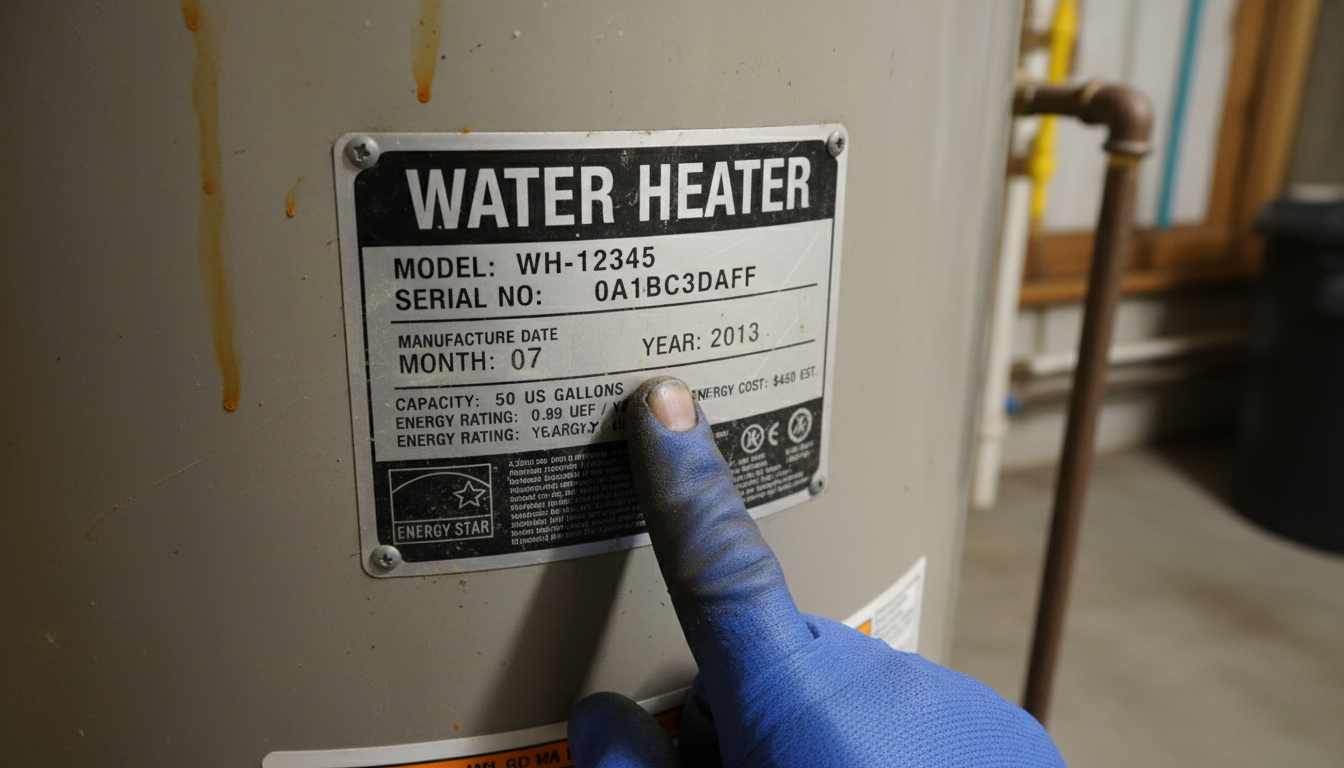
The rating plate on your water heater shows the manufacture date, capacity, and model number — key information for planning a replacement.
- Age 10+ years. If your water heater is over 10 years old, it's living on borrowed time. Check the serial number on the rating plate — the manufacture date is usually encoded in the first four characters. A plumber can help you decode it if you're unsure.
- Rusty or discoloured hot water. If rust-coloured water is coming only from the hot side, the tank's interior lining is deteriorating. Once the anode rod is consumed and the steel tank starts corroding, a leak is inevitable. This isn't something you can repair — it's a replacement signal.
- Rumbling or popping sounds. Sediment buildup on the bottom of the tank hardens over time and causes popping or rumbling during heating cycles. Flushing the tank annually can prevent this, but if the sounds persist after a flush, the sediment layer is too thick and the tank is working significantly harder than it should.
- Water pooling around the base. Any moisture or puddles around the bottom of the water heater indicate a slow leak. This will only get worse. A leaking tank cannot be repaired — and the leak can become a flood without warning. If you see water, call us immediately.
- Not enough hot water. If your water heater used to supply plenty of hot water but now runs out faster, the heating element (electric) or burner assembly (gas) may be failing, or sediment buildup is reducing the effective tank capacity. Sometimes a repair is possible, but in older units, replacement is usually more cost-effective.
- Higher energy bills. A water heater losing efficiency will use more gas or electricity to produce the same amount of hot water. If your energy bills have crept up without an obvious explanation, your aging water heater may be the culprit. Water heating accounts for roughly 20% of the average Ontario home's energy costs.
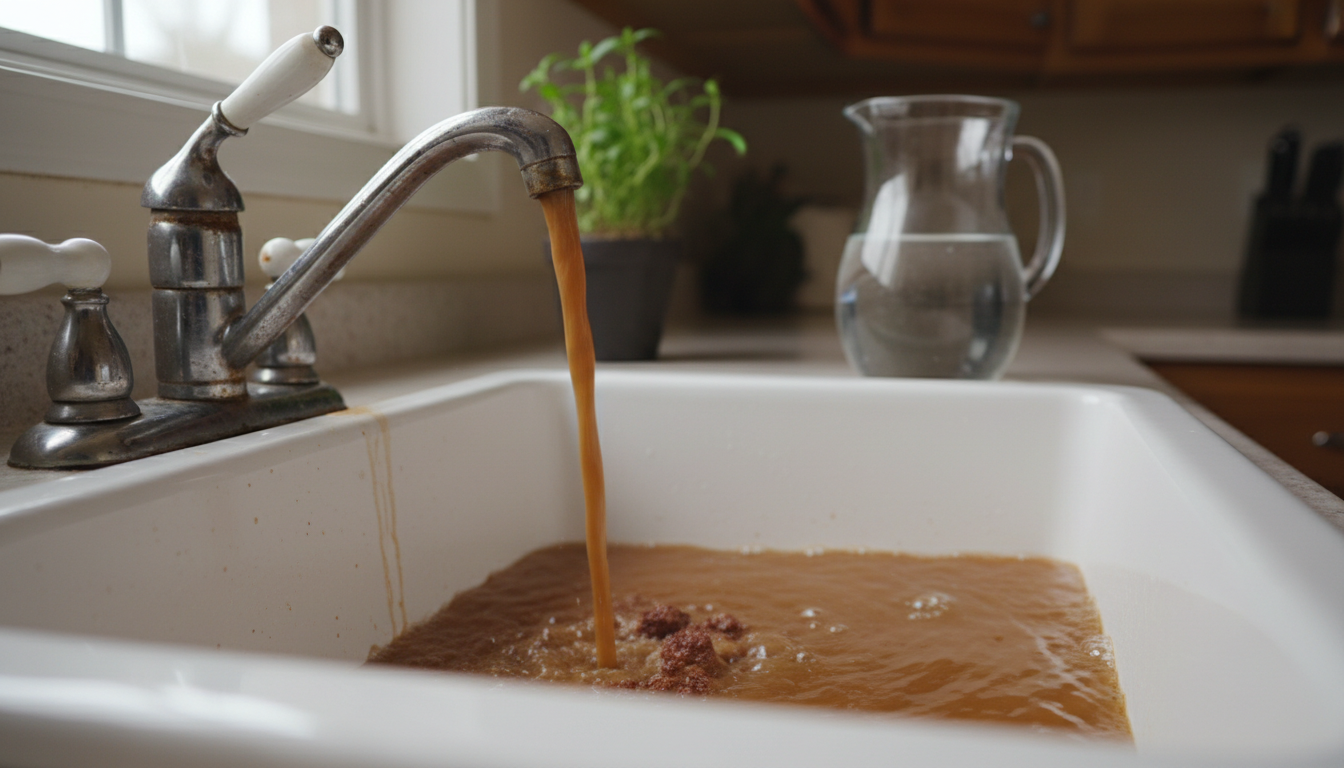
Rust-coloured hot water is a clear sign of internal tank corrosion — replacement, not repair, is the answer.
Energy Efficiency in Ontario
Energy costs matter — especially in Ontario, where electricity prices are among the highest in Canada. Choosing the right water heater efficiency level can save hundreds of dollars per year.
EnerGuide Ratings
Every water heater sold in Canada carries an EnerGuide label that shows the unit's annual energy consumption in gigajoules (GJ) or kilowatt-hours (kWh). Lower numbers mean less energy consumed. The label also shows how the unit compares to similar models — look for units in the top 25% of their category.
Uniform Energy Factor (UEF) is the efficiency metric used for water heaters. A higher UEF means more of your energy goes to heating water rather than being wasted. For gas tank heaters, standard efficiency is around 0.58–0.62 UEF, while high-efficiency models hit 0.65–0.70 UEF. Condensing models reach 0.80+ UEF.
Gas vs Electric in Ontario
In Northern Ontario, natural gas is available in most of North Bay proper, but many rural properties in Callander, Corbeil, and Bonfield rely on propane or electricity. Here's how the costs compare.
- Natural gas is typically the cheapest option to operate. A standard gas water heater costs roughly $300–$400/year to run. A high-efficiency gas model drops that to $200–$300/year.
- Electric water heaters are cheaper to purchase but more expensive to operate in Ontario due to high electricity rates. Annual operating costs run $500–$700 for a standard electric tank. However, electric models are 98%+ efficient at converting electricity to heat — the issue is the cost per kWh, not the efficiency.
- Propane costs fall between natural gas and electricity, but fluctuate more with market prices. Typical annual costs run $400–$600.
High-Efficiency Options Worth Considering
- Condensing gas water heaters capture heat from exhaust gases that standard models vent outside. UEF ratings of 0.80–0.95 mean significantly lower gas bills. They cost $500–$1,000 more than standard gas models but can pay for themselves in 3–5 years through energy savings.
- Heat pump water heaters extract heat from surrounding air to heat water, using 2–3x less electricity than conventional electric models. Operating costs drop to $150–$250/year. The catch: they work best in spaces that stay above 5°C year-round and need adequate air space around them. A heated basement in a North Bay home can work well. An unheated garage will not.
- Hybrid heat pump models combine heat pump technology with a conventional electric element for high-demand periods. These are the most versatile electric option and qualify for various rebate programs.
What Does a New Water Heater Cost in North Bay?
Let's talk real numbers. These are typical fully-installed costs in the North Bay area, including the unit, labour, permits, and basic disposal of the old unit.
Tank Water Heaters — Installed
- Standard efficiency gas (40–50 gal): $1,500–$2,200
- High-efficiency gas (40–50 gal): $2,000–$2,800
- Power-vent gas (50–60 gal): $2,200–$3,000
- Standard electric (40–50 gal): $1,200–$1,800
- Heat pump electric (50 gal): $2,500–$3,500
Tankless Water Heaters — Installed
- Gas tankless (standard install): $3,500–$5,000
- Gas tankless (tank-to-tankless conversion): $4,500–$6,000+
- Electric tankless (whole-home): $2,500–$4,000
Factors That Affect Your Price
- Venting changes. Switching from atmospheric vent to power vent or direct vent adds $300–$800.
- Gas line upgrades. Tankless units often need a larger gas line — adding $500–$1,500 depending on the run length.
- Code upgrades. Older homes may need updated expansion tanks, drain pans, or seismic straps to meet current Ontario Building Code requirements. These are relatively minor costs ($100–$300) but are required on every new installation.
- Accessibility. A unit in an open basement is straightforward. A unit wedged into a tight closet, attic, or crawl space takes longer and costs more to install.
- Permit fees. A plumbing/mechanical permit is required for water heater replacement in North Bay. Permit costs vary but are typically $75–$150. Always ensure your installer pulls the proper permit — unpermitted work can create insurance and resale issues.
Want an exact quote for your home? We provide free, no-obligation estimates. Call 705-482-1253 or check our pricing page for more details.
Rent vs Buy in Ontario
Ontario is unique in Canada — water heater rental programs are extremely common here. Companies like Reliance, Enercare, and others have been renting water heaters to Ontario homeowners for decades. But is renting actually a good deal? Let's look at the real numbers.
The Rental Model
- Typical rental cost: $30–$55/month for a standard tank water heater. Tankless rentals run $55–$80/month.
- What's included: The unit, installation, maintenance, and repair/replacement if it breaks down. No upfront cost.
- The catch: Rental contracts are typically 10–15 years, and early termination fees can be $500–$1,500. The rental stays with the property when you sell, and the new owner inherits the contract — which can complicate real estate transactions.
The True 10-Year Cost Comparison
Here's where the math gets interesting.
- Renting a standard gas tank: $35/month × 120 months = $4,200 over 10 years
- Buying a standard gas tank: $2,000 installed + $200 in maintenance (one anode rod replacement + flush) = $2,200 over 10 years
- Renting a tankless unit: $65/month × 120 months = $7,800 over 10 years
- Buying a tankless unit: $4,500 installed + $600 in maintenance (annual descaling) = $5,100 over 10 years
The Bottom Line on Renting
Buying saves $2,000–$2,700 over 10 years compared to renting for both tank and tankless units. The only scenario where renting makes sense is if you genuinely cannot afford the upfront cost of purchasing — and even then, you might be better served by financing through your installer.
If you currently have a rental water heater and it's nearing end-of-contract, that's the ideal time to buy out or return the unit and purchase your own. We can handle the entire transition — call 705-482-1253 to discuss your options.
One more thing to consider: when you own your water heater, you choose the brand, model, and efficiency level. Rental companies install whatever unit maximizes their margin — not necessarily the best unit for your home. Ownership means you're in control of the quality and efficiency of one of the most-used appliances in your house.
Ready to Replace Your Water Heater?
Whether you're dealing with an emergency replacement or planning ahead, we'll help you choose the right water heater for your home, your family, and your budget. Free estimates, licensed installation, and honest advice — guaranteed.
Call 705-482-1253