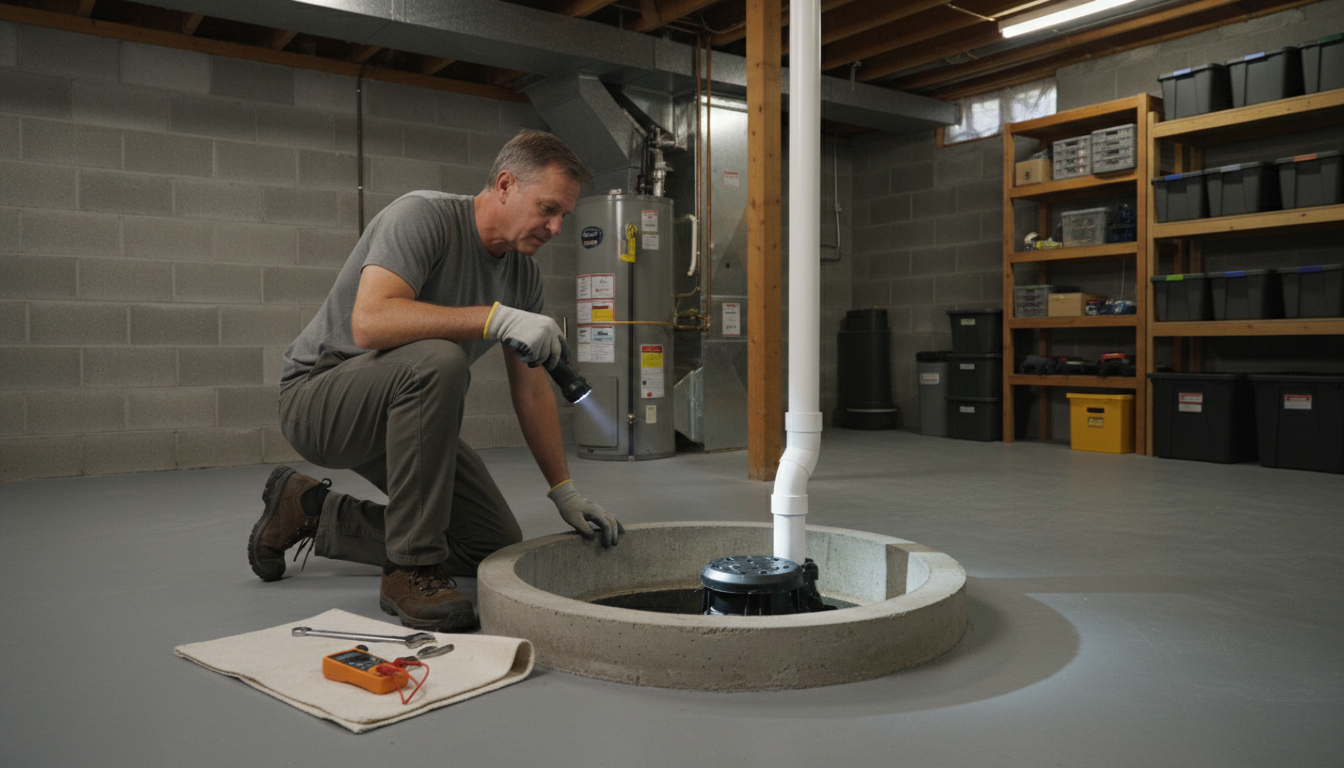
Checking a sump pump in a North Bay basement — regular maintenance prevents costly flooding surprises.
Regular sump pump maintenance prevents basement flooding — the single most common and expensive water damage event for North Bay homeowners. Test your pump monthly by pouring water into the pit, clean the pit and intake screen twice a year, and install a battery backup to protect against power outages during spring storms. A well-maintained sump pump lasts 7–10 years and keeps your basement dry through the worst of spring melt and summer storms.
Your sump pump sits in the lowest corner of your basement, quietly doing its job — until it doesn't. When a sump pump fails during a spring melt or a heavy rainstorm, the result is thousands of dollars in water damage, ruined belongings, and a mould problem that can take months to fully remediate. In the North Bay area, where high water tables and rapid snowmelt are facts of life, your sump pump isn't optional equipment. It's your basement's last line of defence.
The good news: sump pump failures are almost entirely preventable. Most pumps don't fail without warning — they give clear signs that something is wrong. A simple maintenance routine that takes 15 minutes a month can mean the difference between a dry basement and a $10,000 insurance claim.
Why Sump Pump Maintenance Matters in North Bay
North Bay's geography and climate create conditions that put extraordinary demands on residential sump pumps. Understanding why maintenance matters here — more than in most Canadian cities — starts with understanding what your pump is up against.
Spring melt pushes massive volumes of water through the ground. North Bay averages over 200 cm of snowfall each winter. When that snow melts — often rapidly during warm spells in late March and April — the ground becomes saturated with meltwater. That water has to go somewhere, and much of it ends up pushing against your foundation walls and up through the ground beneath your basement slab. Your sump pump may run continuously for days or even weeks during peak melt. A pump that hasn't been maintained may not survive the marathon.
The water table in many North Bay neighbourhoods is naturally high. Properties near Lake Nipissing, along Trout Lake, and in low-lying areas of West Ferris and Callander sit on water tables that can rise dramatically during spring and after heavy rains. Some homes in these areas have sump pumps that run year-round, not just seasonally. The harder and more frequently your pump runs, the more critical regular maintenance becomes.
Power outages during spring storms leave your basement unprotected. North Bay is no stranger to ice storms and heavy wind events in March and April — exactly when your sump pump is working hardest. A power outage during peak spring melt means your pump stops running while water continues to pour in. Without a battery backup system, you can go from dry basement to inches of standing water in a matter of hours. Power outages are the number one cause of sump pump-related flooding in our service area.
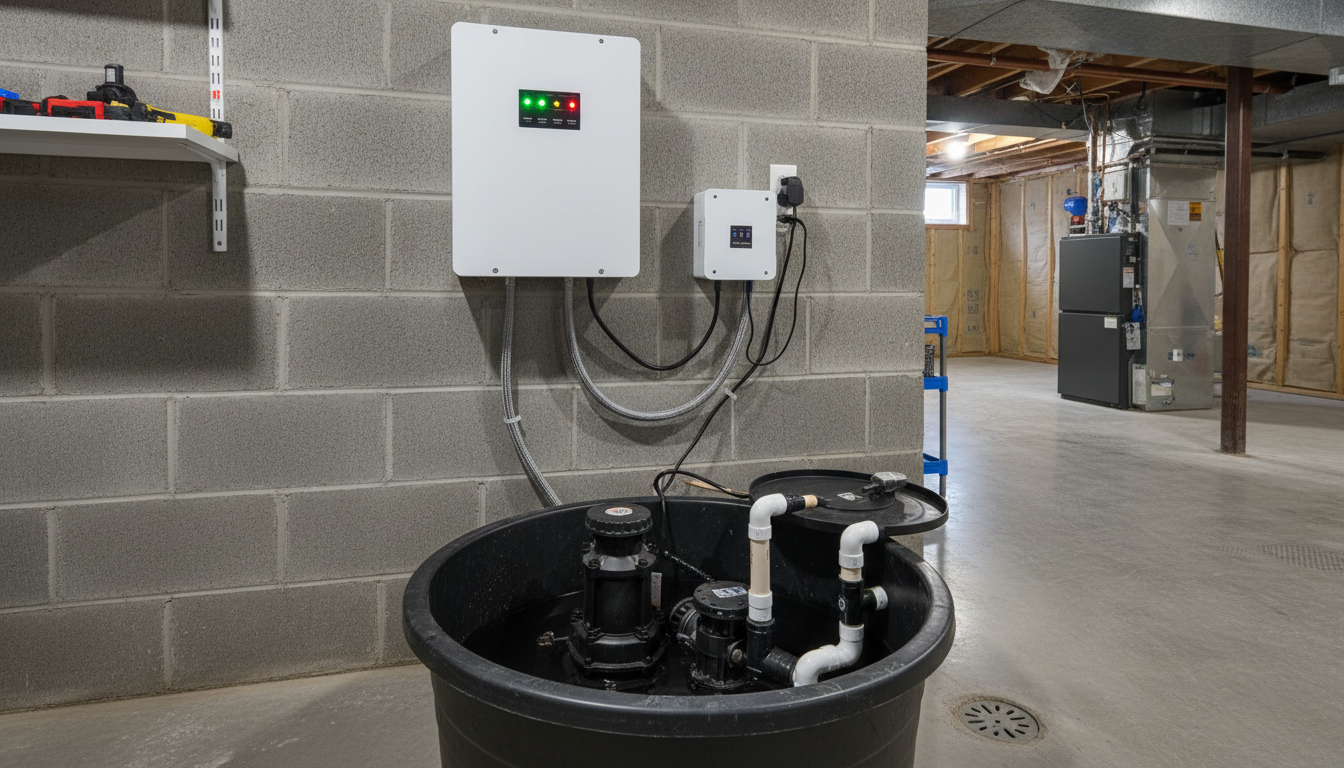
A battery backup system installed alongside the primary sump pump — essential insurance against power outages during spring storms.
Monthly Maintenance Checklist
Monthly sump pump testing takes about 15 minutes and requires no special tools. Make it part of your routine — the first of every month, or pick a day you'll remember. Here's exactly what to check.
Pour Water to Test the Pump
This is the most important test. Slowly pour a 5-gallon bucket of water into the sump pit. The float switch should rise as the water level increases, the pump should activate automatically, and the water should be pumped out within 10–15 seconds. Watch the entire cycle. If the pump doesn't turn on, turns on but doesn't pump water, or takes significantly longer than usual to empty the pit, you have a problem that needs attention before it becomes an emergency.
Check the Float Switch
The float switch is the mechanism that tells the pump when to turn on and off. Reach into the pit (with the pump unplugged) and manually move the float up and down. It should move freely without catching on the pit walls, the discharge pipe, or the power cord. A stuck float switch is the most common cause of sump pump failure — and the easiest to prevent. If your float has accumulated mineral deposits or debris, clean it with a damp cloth.
Listen for Unusual Sounds
When the pump runs during your water test, listen carefully. A healthy sump pump produces a steady, even hum. Grinding, rattling, or thunking sounds indicate worn bearings, a damaged impeller, or debris caught inside the pump. Unusual sounds don't fix themselves — they get worse. If your pump sounds different from normal, schedule a professional inspection before it fails completely.
Verify the Discharge Pipe Is Clear
Go outside and check where your sump pump discharge pipe exits the house. The pipe should be clear of debris, leaves, ice, and obstructions. Water should be able to flow freely away from your foundation. If the discharge pipe is blocked, the pump will run but the water has nowhere to go — it backs up and either overflows the pit or burns out the pump motor. In winter, check for ice blockages at the discharge point. During spring and fall, clear any leaves or debris that have accumulated.
Quick Monthly Test Summary
- Pour a bucket of water into the pit — pump should activate and drain within 15 seconds
- Check the float switch — should move freely without obstruction
- Listen to the pump — should produce a steady hum, no grinding or rattling
- Check discharge outside — pipe exit should be clear and draining away from foundation
- Check the power cord — plugged in securely, no damage, GFCI outlet not tripped
If anything seems off during your monthly test, don't wait for the next storm to find out if it's a real problem. Call 705-482-1253 and get it checked.
Seasonal Maintenance Schedule
Beyond monthly testing, your sump pump needs deeper maintenance at key points throughout the year. Each season brings different challenges, and a few minutes of targeted maintenance at the right time prevents problems when conditions are worst.
Spring: Pre-Melt Check (Late February / Early March)
This is the most critical maintenance window of the year. Before the spring melt begins in earnest, do a thorough pre-season inspection. Run the bucket test. Check and clean the float switch. Inspect the discharge pipe for ice blockages — in North Bay, discharge pipes often freeze solid during January and February. If the discharge is frozen, thaw it before melt begins or the pump will have nowhere to send the water. Test your battery backup (see section below). Clean any debris from the sump pit. This is also the ideal time to have a professional sump pump inspection if your pump is more than 5 years old.
Summer: Clean the Pit (June / July)
After the heavy demands of spring melt, summer is the time for a deep clean. Unplug the pump and remove it from the pit. Clean the pump intake screen and impeller housing — sediment, gravel, and mineral deposits accumulate over the spring season and reduce pump efficiency. Clean out the sump pit itself, removing any silt, gravel, or debris that has settled at the bottom. A clogged pit reduces the effective volume and can block water from reaching the pump intake. Inspect the check valve on the discharge pipe — it should open and close freely. Reinstall the pump, plug it back in, and run a bucket test to confirm everything works.
Fall: Pre-Freeze Check (October / November)
Before winter sets in, prepare your sump system for cold weather. Inspect the discharge pipe exterior and make sure it's properly graded away from the foundation — at least 6 feet of distance. Clear any leaves or debris from around the discharge point. Check that the discharge pipe has a proper stormwater drainage path and won't create ice buildup near your foundation. If your discharge pipe runs above ground for any distance, consider insulating it or installing a freeze guard (a pop-off fitting that lets water escape if the line freezes). Test the battery backup and replace batteries if they're more than 2–3 years old.
Winter: Verify Discharge Isn't Frozen (Monthly)
During winter, your primary concern is a frozen discharge line. Check the exterior discharge point at least monthly — more often during prolonged cold snaps. If you see ice forming at the pipe exit, address it immediately. A frozen discharge is just as dangerous as a pump failure — the pump runs, but the water has nowhere to go. Signs of a frozen discharge include the pump cycling on and off rapidly, water backing up into the pit despite the pump running, or visible ice at the exterior discharge point.
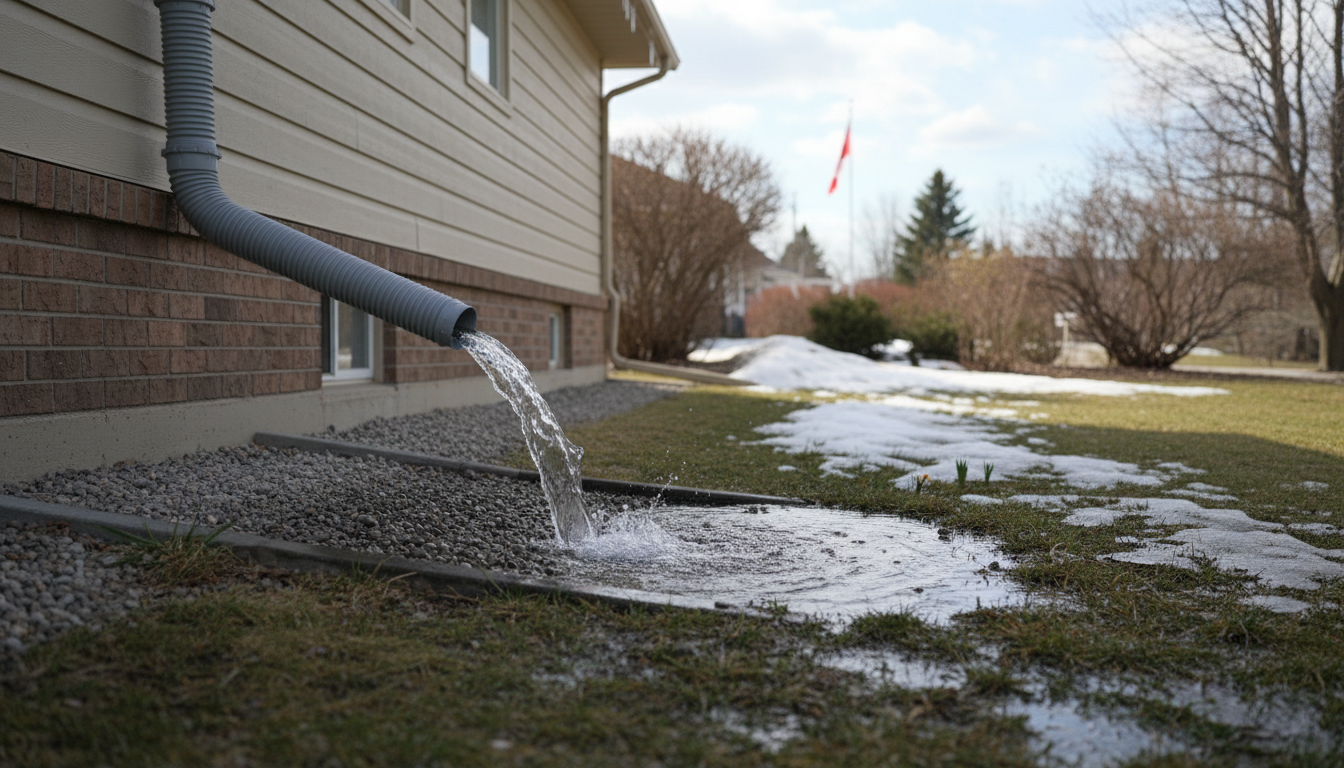
A clear discharge pipe during spring melt — water flowing freely away from the foundation, exactly as it should.
Battery Backup — Non-Negotiable in North Bay
If you have a sump pump without a battery backup, you have a sump pump that will fail you when you need it most. In North Bay, this isn't a nice-to-have — it's essential equipment. Here's why, and what to look for.
Power outages and flooding go hand in hand. The same storms that cause the heaviest rainfall and fastest snowmelt are the storms most likely to knock out power. Spring ice storms, heavy wind events, and thunderstorms all bring water and power outages simultaneously. Without a battery backup, your basement is unprotected during exactly the conditions that produce the most groundwater.
Battery Types
Standard lead-acid batteries are the most common and most affordable option. They typically provide 5–7 hours of pump operation on a full charge, depending on how frequently the pump cycles. They need to be replaced every 3–5 years. Maintenance-free AGM (Absorbed Glass Mat) batteries last longer, perform better in cold temperatures (important in North Bay basements), and don't require water level checks. They cost more upfront but are the better investment for our climate. Combination primary/backup systems include a second pump with its own battery-powered motor mounted above the primary pump. These provide redundancy — if the primary pump fails for any reason, the backup pump takes over automatically.
Testing Your Battery Backup
Test your battery backup quarterly — and always before spring melt season. Unplug the primary pump from the wall outlet, then pour water into the pit. The battery backup system should detect the rising water and activate the backup pump. If it doesn't, the battery may be dead, the backup pump may have failed, or the float switch on the backup system may be stuck. Most battery backup systems have an indicator light or alarm that shows battery charge status — check it monthly. Replace the battery according to the manufacturer's schedule, or immediately if it fails a test.
Professional battery backup installation typically costs $400–$900 depending on the system type. Compare that to the average basement flood cleanup cost of $5,000–$15,000, and the math is obvious. If you need a battery backup installed or your existing system inspected, our sump pump service team can handle it.
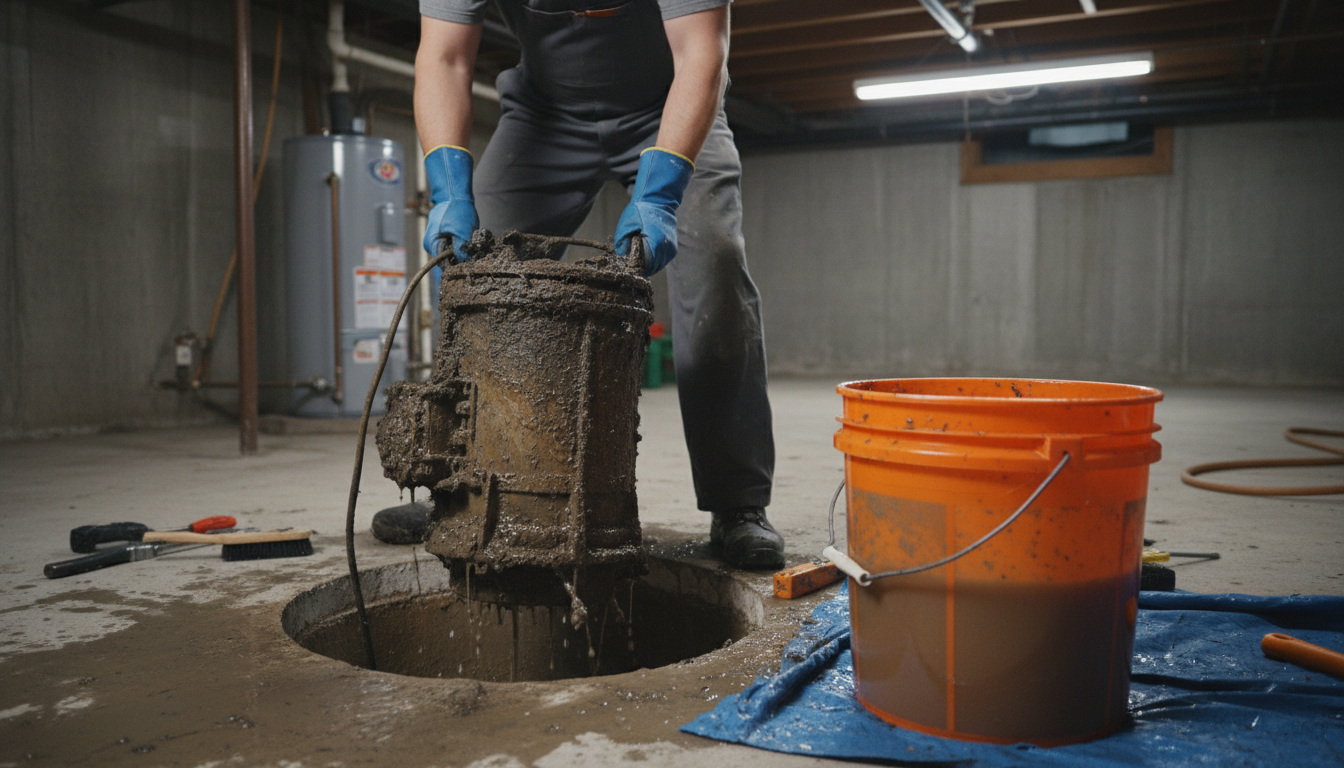
Professional sump pump cleaning during a maintenance service — removing sediment and debris that reduce pump performance.
5 Signs Your Sump Pump Is Failing
Sump pumps rarely fail without warning. If you pay attention, you'll usually get clear signals that something is wrong — days, weeks, or even months before a complete failure. Here are the five most common warning signs, ranked by urgency.
- Running constantly or almost constantly. If your pump runs non-stop even when there's no active rain or melt, something is wrong. The most common causes: a stuck float switch, a check valve that's failed (allowing water to flow back into the pit after each cycle), or an undersized pump that can't keep up with the water inflow. Constant running will burn out the pump motor — it's designed for intermittent operation, not continuous duty. This needs immediate professional attention.
- Cycling on and off rapidly (short cycling). If the pump turns on, runs for a few seconds, shuts off, then turns on again within a minute or two, the float switch is likely malfunctioning or set incorrectly. Short cycling stresses the motor and dramatically shortens the pump's lifespan. It can also indicate that the sump pit is too small for the water volume — common in older North Bay homes where the original pit was undersized for current conditions.
- Strange noises — grinding, rattling, or thunking. These sounds indicate mechanical failure in progress. Grinding usually means worn bearings. Rattling suggests a loose or damaged impeller. Thunking can mean debris is caught inside the pump housing. Any unusual noise from a sump pump is a warning that the pump is close to failure. Don't ignore it and hope it goes away — it won't.
- Visible rust, corrosion, or discolouration. If you see rust-coloured water in the sump pit, orange or brown staining on the pump body, or corroded connections, the pump's internal components are deteriorating. Iron bacteria (common in North Bay's groundwater) can also cause reddish-brown buildup that clogs the pump intake and reduces performance. Corrosion is progressive — once it starts, it accelerates. A corroded pump needs to be replaced, not repaired.
- The pump is 7–10 years old. Even with perfect maintenance, sump pumps have a finite lifespan. Most residential sump pumps last 7–10 years. If your pump is approaching or past that age, don't wait for it to fail during a spring storm. Proactive replacement on your schedule is always better — and cheaper — than emergency replacement during a flood. If your pump is older than 7 years, ask us about a sump pump replacement before next spring.
When to Call a Professional
Basic monthly testing and seasonal cleaning are well within any homeowner's ability. But certain situations require a licensed plumber with the right tools and experience. Call a professional if:
- Your pump fails the bucket test. If you pour water in and the pump doesn't activate, doesn't pump the water out, or takes significantly longer than usual, something is wrong internally. Diagnosing and repairing sump pump issues requires pulling the pump, inspecting the motor, impeller, float switch, and check valve, and testing electrical components.
- You're experiencing any of the 5 warning signs above. Constant running, short cycling, strange noises, corrosion, or an aging pump all warrant professional evaluation. The cost of an inspection is a fraction of the cost of a flood.
- You need a battery backup installed. Battery backup systems involve electrical connections and must be properly sized to match your primary pump's capacity and your home's water inflow rate. An undersized backup is worse than no backup — it gives you false confidence.
- Your basement has flooded or is actively flooding. If water is coming in, call 705-482-1253 immediately. We provide emergency basement waterproofing and sump pump repair across North Bay and surrounding areas. The faster you get a working pump in place, the less damage you'll sustain.
- You're buying a home and want the sump system inspected. A pre-purchase sump pump inspection can reveal problems that a standard home inspection often misses — undersized pits, failed check valves, missing battery backups, and discharge pipes that terminate too close to the foundation.
- You want to upgrade your entire sump system. If your home has chronic water issues, an upgraded system with a larger pit, higher-capacity pump, battery backup, and proper stormwater drainage can solve the problem permanently. We design and install complete basement water management systems tailored to North Bay's specific conditions.
For any sump pump issue — routine maintenance, emergency repair, or full system installation — call 705-482-1253. We service all makes and models and carry the most common replacement pumps on our trucks for same-day installation.
Keep Your Basement Dry Year-Round
Whether you need a sump pump inspection, battery backup installation, or emergency repair during a flood, we're here to help. One call gets it handled.
Call 705-482-1253