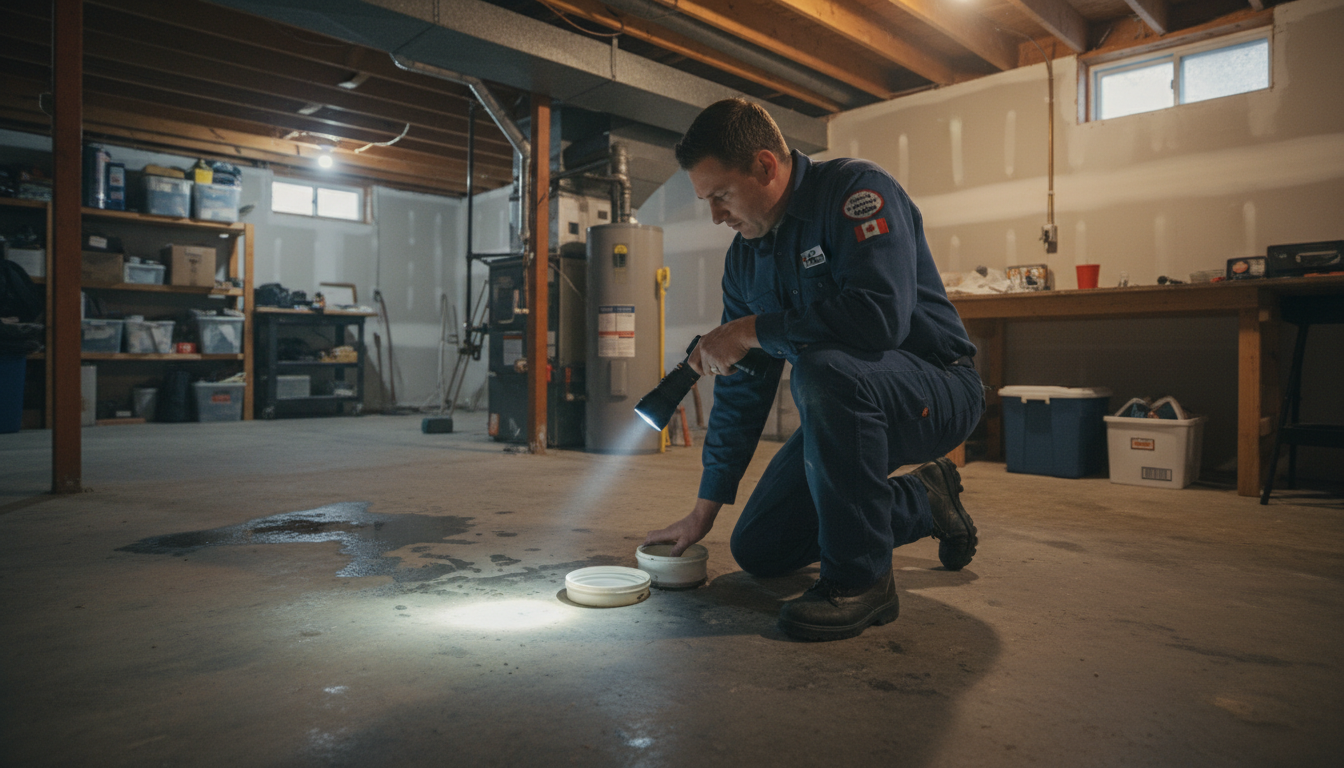
A licensed plumber inspecting a sewer line cleanout in a North Bay basement — the first step in diagnosing sewer problems.
Most sewer line failures don't happen overnight. Warning signs — slow drains, gurgling sounds, sewage odours, wet spots in the yard — appear months or even years before a full collapse. Recognizing these signs early can save you thousands of dollars in emergency repairs and property damage.
Your sewer lateral is the underground pipe that carries all wastewater from your home to the municipal sewer main under the street. It's buried, invisible, and easy to ignore — until something goes wrong. In North Bay, where many homes sit on aging clay pipe systems installed in the 1950s through 1970s, sewer line problems are more common than most homeowners realize.
The good news: your sewer line almost always warns you before it fails completely. Here are the five signs to watch for, why North Bay homes are especially vulnerable, and what your repair options look like.
5 Warning Signs Your Sewer Line Is Failing
A failing sewer line rarely announces itself with a dramatic backup on day one. Instead, it sends a series of smaller signals that many homeowners dismiss or attribute to other causes. Pay attention to these five warning signs — especially if you notice more than one at the same time.
- Slow drains in multiple fixtures. A single slow drain usually means a localized clog — hair in the bathroom sink, grease in the kitchen drain. But when two or more fixtures start draining slowly at the same time, that points to a problem deeper in the system. If your basement floor drain, downstairs toilet, and shower are all sluggish, the issue is likely in your main sewer lateral, not in individual branch lines. This is the earliest and most common warning sign. Many homeowners pour drain cleaner into individual fixtures for months before realizing the real problem is underground. If you're dealing with recurring slow drains, it's time to look at the sewer line itself.
- Gurgling sounds from drains or toilets. When you hear gurgling or bubbling sounds coming from a drain or toilet — especially when you're using a different fixture — that's air being displaced in the pipe system. In a properly functioning sewer line, wastewater flows smoothly and air vents through the roof stack. Gurgling means something is restricting flow and forcing air backward through the water traps. Listen for it when you flush a toilet upstairs and hear bubbling from the basement floor drain. Or when the washing machine drains and the kitchen sink gurgles. These cross-fixture symptoms are a reliable indicator of a partial sewer line blockage.
- Sewage odour inside or outside the house. You should never smell sewage in or around your home. The plumbing system is designed to be airtight — water traps in every drain prevent sewer gas from entering the living space. If you're catching whiffs of rotten eggs or raw sewage — in the basement, near floor drains, or in the yard — something has broken the seal. Common causes include a cracked sewer pipe allowing gas to seep through the soil, a bellied pipe section where waste is pooling and decomposing, or a failed connection joint. Persistent sewage odour in the yard, particularly along the path between your home and the street, is a strong indicator of a sewer line crack or separation.
- Wet spots, sinkholes, or unusually green patches in the yard. Your sewer lateral runs underground from your home to the municipal connection, typically under the front yard or side yard. If the pipe cracks or separates, sewage leaks into the surrounding soil. The visible result: unexplained wet or soggy areas in the yard, patches of grass that are noticeably greener and lusher than the surrounding lawn (sewage is a fertilizer), or shallow depressions and sinkholes where the soil is washing away around the broken pipe. In winter, you might notice areas where snow melts faster than the rest of the yard. If you see any of these signs along the path between your house and the street, a sewer line inspection should be your next step.
- Foundation cracks, settling, or moisture in the basement. A leaking sewer line near or under your foundation can wash away the supporting soil over time, causing the foundation to shift and crack. While foundation issues have many possible causes, if you notice new cracks appearing in your foundation walls combined with any of the other signs on this list, the sewer line should be investigated. Unexplained moisture, mould, or water stains on basement walls near where the sewer line exits the building are another red flag. A cracked sewer pipe under the basement slab can also allow sewage to seep up through floor cracks — one of the most unpleasant and expensive scenarios to remediate.
If you're experiencing two or more of these signs simultaneously, the probability of a sewer line problem is high. Don't wait for a full backup. A sewer camera inspection can confirm the diagnosis and show you exactly what's happening inside the pipe.
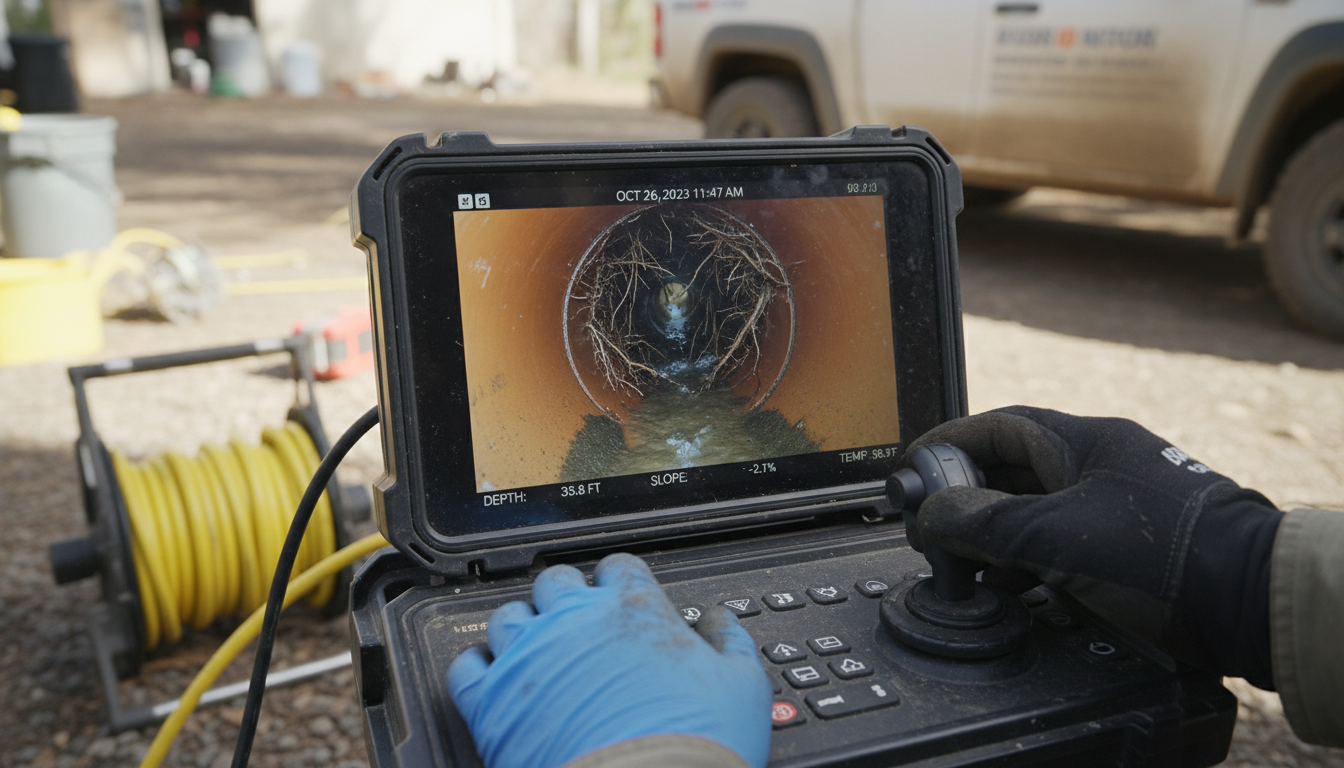
Sewer camera footage showing tree root intrusion through a joint in an aging clay pipe — one of the most common causes of sewer failure in North Bay.
Why North Bay Sewer Lines Fail
North Bay has a combination of factors that make sewer line failures more common than in many other Ontario cities. Understanding why helps you assess your own risk and take preventive action before a problem becomes an emergency.
Aging Clay Laterals in West Ferris and Downtown
A large portion of the homes in West Ferris, downtown North Bay, and the south end were built between the 1950s and 1970s. The sewer laterals installed during that era are almost exclusively clay (vitrified clay pipe). Clay pipe has a functional lifespan of 50 to 75 years — which means many of these pipes are at or past their expected service life. Clay is durable but brittle. Over decades, the joints between pipe sections loosen and separate, creating gaps where roots enter and soil washes in. The pipe walls themselves can crack from ground pressure or settle unevenly. If your home was built before 1980 and the sewer lateral has never been replaced, it's operating on borrowed time.
Tree Root Infiltration
North Bay's mature tree canopy is one of the city's best features — but tree roots are the number one cause of sewer line failure in residential areas. Roots are drawn to the moisture and nutrients inside sewer pipes. They enter through loose joints, small cracks, or any imperfection in the pipe wall. Once inside, they grow rapidly, creating a dense root mass that traps debris and progressively blocks the pipe. Species like silver maples, willows, and elms are especially aggressive, but any mature tree within 10 to 15 metres of your sewer line is a potential problem. Root intrusion is a progressive condition — it starts small and gets worse every season.
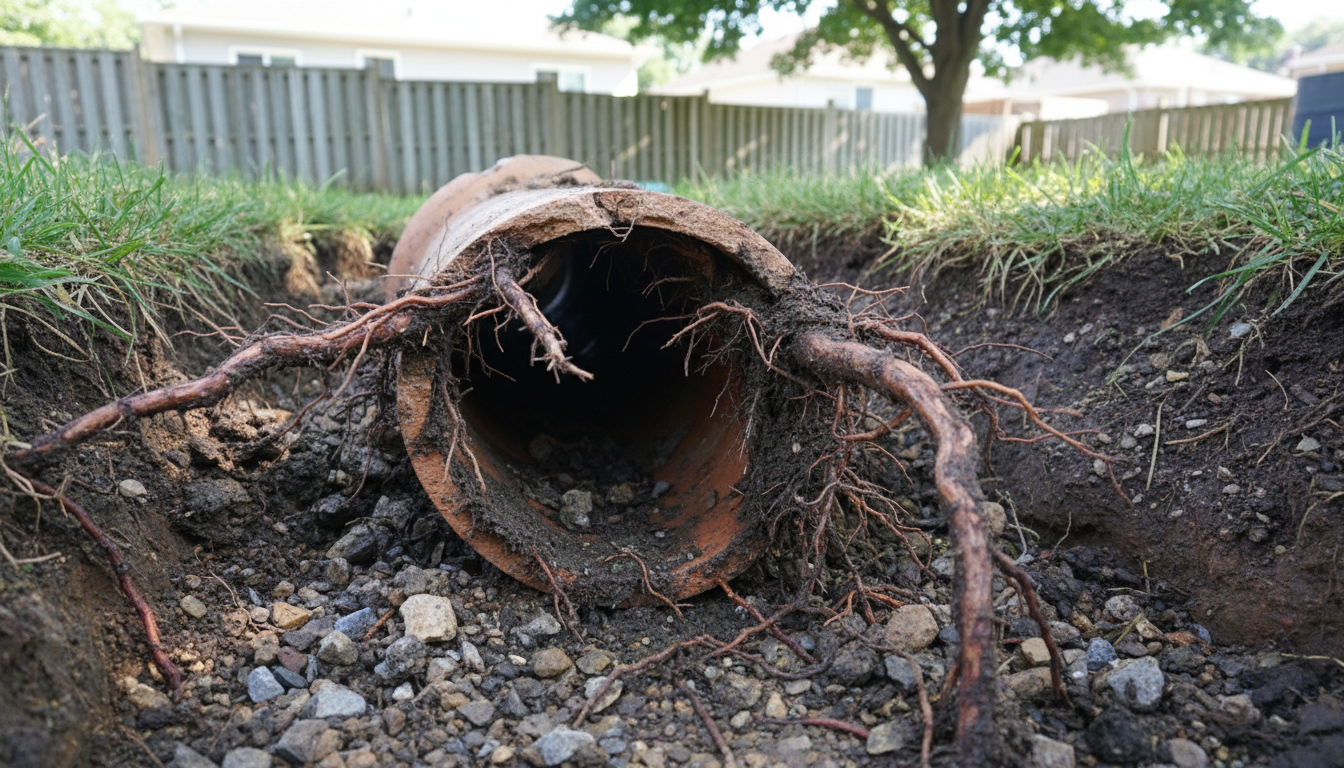
A cracked clay sewer pipe excavated during a repair in North Bay — tree roots have penetrated and widened the original crack.
Freeze-Thaw Ground Movement
Northern Ontario's extreme freeze-thaw cycle puts enormous stress on underground pipes. The frost line in the North Bay area extends 4 to 5 feet deep. Each winter, the ground freezes and expands; each spring, it thaws and contracts. This annual cycle shifts the soil around buried pipes, causing clay joints to separate, rigid pipes to crack, and bellied (sagging) sections to form where the pipe settles into voids. Homes built on clay-heavy soils — common in many North Bay neighbourhoods — are especially susceptible because clay soil expands more during freezing than sandy or gravel soils.
Bellied and Sagging Pipes
A "belly" in a sewer line is a section that has sunk below the rest of the pipe's grade, creating a low point where water and waste collect instead of flowing through. Bellied pipes are caused by ground settlement, soil washout, or poor original installation. The pooled waste in a belly creates a chronic partial blockage, accelerates pipe deterioration, and often becomes a site where root intrusion takes hold. Bellied sections don't fix themselves — they get progressively worse over time and eventually require repair or replacement.
What a Sewer Camera Inspection Reveals
A sewer camera inspection is the only way to see exactly what's happening inside your sewer line without excavation. It's the diagnostic step that turns guesswork into a clear repair plan.
How It Works
A licensed plumber inserts a waterproof, high-resolution camera attached to a flexible cable into your sewer cleanout (the capped access point, usually in the basement or outside near the foundation). The camera travels through the entire length of your sewer lateral to the municipal connection, transmitting live video to a monitor. The technician can see the pipe's interior condition in real time and record the footage for your records.
What the Plumber Looks For
During the inspection, the technician is evaluating several specific conditions:
- Root intrusion — visible roots entering through joints or cracks, ranging from minor hair-like roots to dense root masses that fill the pipe
- Cracks and fractures — longitudinal cracks, circumferential breaks, or fragmented pipe sections
- Joint separation — gaps between pipe sections where the original joints have failed, allowing soil and root infiltration
- Bellied sections — low points where the camera passes through standing water, indicating the pipe has settled out of grade
- Grease or debris buildup — accumulated deposits that are narrowing the pipe's effective diameter
- Pipe material and condition — identifying whether the pipe is clay, cast iron, orangeburg, or PVC, and its overall structural integrity
- Offset joints — misaligned pipe sections that create ledges where waste catches and builds up
Cost and When to Get One
A sewer camera inspection in North Bay typically costs $200 to $400, depending on the length and accessibility of the line. It's one of the best diagnostic investments you can make. We recommend a camera inspection in three situations: when you're experiencing any of the warning signs listed above, when you're buying a home (especially one built before 1980), and as a preventive measure every 3 to 5 years on homes with mature trees near the sewer line.
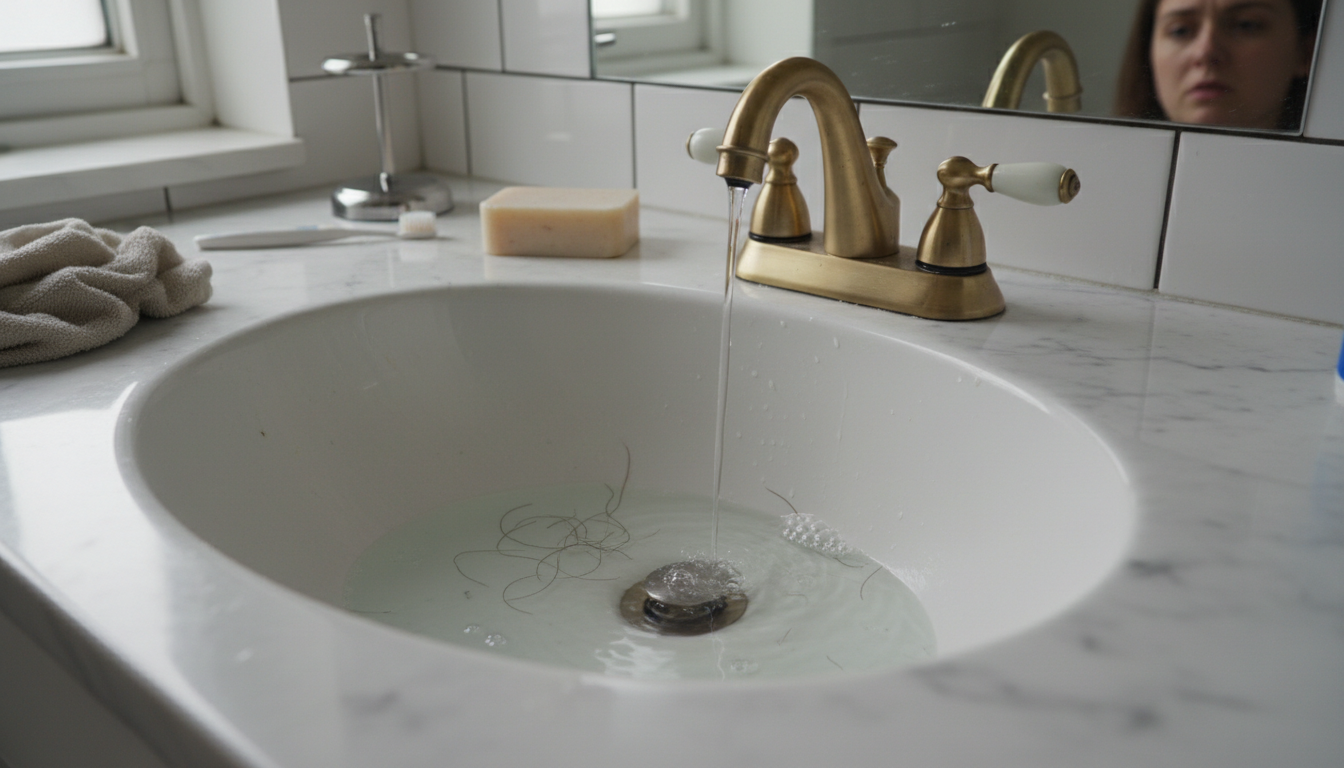
A slow-draining bathroom sink may seem minor — but when multiple fixtures drain slowly, it's often the first sign of a deeper sewer line problem.
Repair Options — Traditional vs Trenchless
Once a camera inspection confirms sewer line damage, the next question is how to fix it. There are two main approaches, and the right choice depends on the type of damage, its location, and the condition of the existing pipe.
Traditional Excavation Repair
Traditional repair involves excavating the ground above the damaged pipe section, removing the failed pipe, and installing new pipe (typically PVC or ABS). This is the oldest and most straightforward repair method. It's necessary when the pipe has completely collapsed, is severely bellied, or has lost its structural shape to the point where a liner can't be inserted.
Typical cost: $3,000 to $10,000+ depending on depth, length, and what's above the pipe (driveway, landscaping, walkways). Excavation in North Bay can be more complex in winter due to frozen ground, which may increase costs.
When traditional excavation is the right choice:
- Complete pipe collapse or severe structural failure
- Significant bellied sections that need to be re-graded
- Pipe material is orangeburg (compressed fibre that disintegrates and can't hold a liner)
- The pipe has multiple severe offsets or back-to-back failure points
Trenchless Pipe Repair (CIPP Lining)
Trenchless pipe repair — most commonly CIPP (cured-in-place pipe) lining — creates a new pipe inside the existing one without excavation. A resin-saturated flexible liner is inserted through the cleanout, positioned inside the damaged pipe, and inflated. The resin cures (hardens) in place, creating a smooth, jointless pipe-within-a-pipe that seals cracks, bridges joint gaps, and blocks root intrusion.
Typical cost: $4,000 to $8,000 for a full lateral lining. While the material cost is higher than traditional pipe, the total project cost is often comparable or lower because there's no excavation, no landscape restoration, and no driveway repair.
When trenchless is the right choice:
- The pipe still has its round shape (structurally intact enough to hold a liner)
- Root intrusion through joints but the pipe walls are sound
- Cracked pipe sections that haven't collapsed
- The pipe runs under a driveway, walkway, or landscaping you want to preserve
- You want a long-term solution (CIPP liners are rated for 50+ years)
In many cases, the camera inspection reveals that part of the line needs excavation and part can be lined — a combination approach that minimizes disruption while ensuring a complete repair. Your plumber should present all options with costs so you can make an informed decision.
How to Protect Your Sewer Line
Whether your sewer line is brand new or 50 years old, these preventive measures will extend its lifespan and reduce the risk of unexpected failures.
Schedule annual root treatment. If you have mature trees within 15 metres of your sewer line, annual root treatment is one of the most cost-effective preventive measures available. A plumber can apply root-killing foam or copper sulfate treatments through the cleanout that kill roots inside the pipe without harming the tree. This should be done annually in spring or early summer when root growth is most active. Combined with periodic drain cleaning, root treatment keeps small root intrusions from becoming major blockages.
Get a camera inspection every 3 to 5 years. For homes with clay pipes, mature trees, or any history of sewer problems, a camera inspection every 3 to 5 years catches developing issues before they become emergencies. Think of it like a dental X-ray for your plumbing — it shows problems you can't see from the surface. The $200–$400 cost of an inspection is a fraction of the $5,000+ cost of an emergency sewer repair.
Never flush grease, wipes, or non-degradable items. Cooking grease, "flushable" wipes (which aren't actually flushable), feminine hygiene products, cotton swabs, and paper towels are the leading causes of preventable sewer blockages. Grease solidifies inside the pipe and creates a surface that catches everything else flowing through. Wipes don't break down and snag on rough pipe surfaces, root masses, and joint offsets. Keep a grease container by the stove and put a wastebasket in every bathroom.
Install a backwater valve. A backwater valve is a one-way valve installed on your sewer lateral that prevents municipal sewer backups from flowing into your home. During heavy rainstorms, the municipal system can overload, and without a backwater valve, that backup flows into the lowest drain in your house — typically the basement floor drain. Most insurance companies in Ontario now require a backwater valve for sewer backup coverage, and many municipalities (including North Bay) offer rebate programs to offset installation costs. Typical installation cost is $2,000 to $4,000.
Know the age and material of your sewer line. If you're buying a home or haven't had your sewer line inspected, find out what it's made of and when it was installed. Clay pipe installed before 1980 is high-priority for inspection. Cast iron pipe from the same era is also at risk of internal corrosion. PVC pipe installed after 1990 is generally in good condition but should still be inspected if you're experiencing symptoms. Your home's building permit records (available from the City of North Bay) may indicate when the sewer line was last replaced.
When It's an Emergency
Call Immediately If You're Experiencing Any of These
- Sewage is backing up into your home. If wastewater is coming up through basement floor drains, toilets, or shower drains, this is an active sewer emergency. Stop using all water in the house immediately — every flush and every drain adds to the backup. The health risk from raw sewage exposure is serious. Call 705-482-1253 for emergency sewer repair.
- Multiple drains are completely blocked simultaneously. When every drain in the house stops working at once, the main sewer lateral is fully obstructed. This is different from a slow drain situation — total blockage means the pipe is either collapsed, fully root-bound, or obstructed by a major break. This will escalate to a full backup quickly if not addressed.
- Sewage is visible in the yard. If you see or smell raw sewage surfacing in your yard, the sewer line has a significant break. This is both a plumbing emergency and a health hazard. Raw sewage on the surface can contaminate soil, reach neighbouring properties, and attract pests. Municipal bylaws require prompt remediation.
- You notice a sudden sinkhole over the sewer line path. A sudden ground depression or sinkhole along the route of your sewer lateral indicates a pipe collapse with active soil washout. This can worsen rapidly and potentially undermine walkways, driveways, or foundations. Mark the area, keep people and vehicles away, and call a plumber.
For any sewer emergency, our 24/7 emergency line is 705-482-1253. We respond within 60 minutes across North Bay, Callander, and surrounding areas.
Between the warning signs and a full emergency, there's a window of opportunity where a planned repair costs a fraction of what an emergency repair costs. A camera inspection during that window is the smartest investment you can make. Emergency sewer repairs typically cost 30 to 50 percent more than planned repairs due to overtime labour, expedited scheduling, and the additional cleanup required after a backup.
If you're seeing any of the warning signs described in this article, don't wait for the emergency. A camera inspection takes less than an hour, and you'll have a clear picture of your sewer line's condition and your options going forward.
Concerned About Your Sewer Line?
Whether you're seeing warning signs, buying a home with older plumbing, or just want peace of mind, we can inspect and diagnose your sewer line the same day. One call gets it handled.
Call 705-482-1253