
Aerial view of a typical septic system layout on a rural property in the North Bay region — tank, distribution box, and drain field clearly visible.
Septic systems serve thousands of homes across the North Bay region, from Callander and Corbeil to Bonfield and rural properties throughout the Nipissing District. If your home isn't connected to municipal sewers, your septic system is the single most important — and most expensive to replace — piece of infrastructure on your property. This guide covers how septic systems work, when to pump, warning signs of failure, maintenance best practices, winterization, and what to expect during a property sale inspection.
Unlike homes in North Bay's urban core that connect to the city's wastewater treatment system, rural and semi-rural properties rely entirely on private septic systems to process household wastewater. That includes everything that goes down every drain, toilet, shower, and washing machine in your home. When a septic system is properly maintained, it works quietly and efficiently for 25 to 30 years or more. When it's neglected, the consequences range from slow drains and foul odours to raw sewage surfacing in your yard — or worse, contaminating your well water.
The Nipissing District's clay-heavy soils, cold winters, and high water tables create unique challenges for septic systems that homeowners in southern Ontario don't face. This guide is written specifically for conditions in North Bay, Callander, Corbeil, and surrounding areas.
How Your Septic System Works
A septic system is simpler than most people think. It has three main components, and understanding each one helps you maintain the whole system properly.
The Septic Tank
All wastewater from your home flows into a buried concrete, fibreglass, or polyethylene tank — typically 3,600 to 4,500 litres (800 to 1,000 gallons) for a standard 3-bedroom home. Inside the tank, solid waste settles to the bottom as sludge, while oils and grease float to the top as scum. The relatively clear liquid in the middle — called effluent — flows out of the tank through an outlet baffle.
Naturally occurring bacteria inside the tank break down a portion of the solids over time. But they can't break down everything, which is why regular pumping is essential. The solids that bacteria can't process accumulate in the tank year after year. If they build up too high, they'll flow out with the effluent and clog your drain field — the most expensive component to replace.
The Drain Field (Leaching Bed)
Effluent from the tank flows into a network of perforated pipes buried in gravel-filled trenches across your yard. This is your drain field, also called a leaching bed in Ontario. As effluent trickles through the gravel and into the surrounding soil, bacteria in the soil provide the final treatment — removing harmful pathogens, nutrients, and contaminants before the water reaches the groundwater table.
A healthy drain field is invisible. You shouldn't see wet spots, smell anything, or notice unusually green grass over the trenches. If you do, that's a warning sign we'll cover below.
The Soil
The soil beneath and around your drain field is the final treatment stage. Different soil types process effluent at different rates. Sand and sandy loam drain quickly and provide excellent treatment. The clay soils common in the Callander and rural North Bay area drain more slowly, which is why drain fields in our region are often designed larger than you'd see in areas with sandier soil. If your property has heavy clay, your system was (or should have been) engineered to account for it.
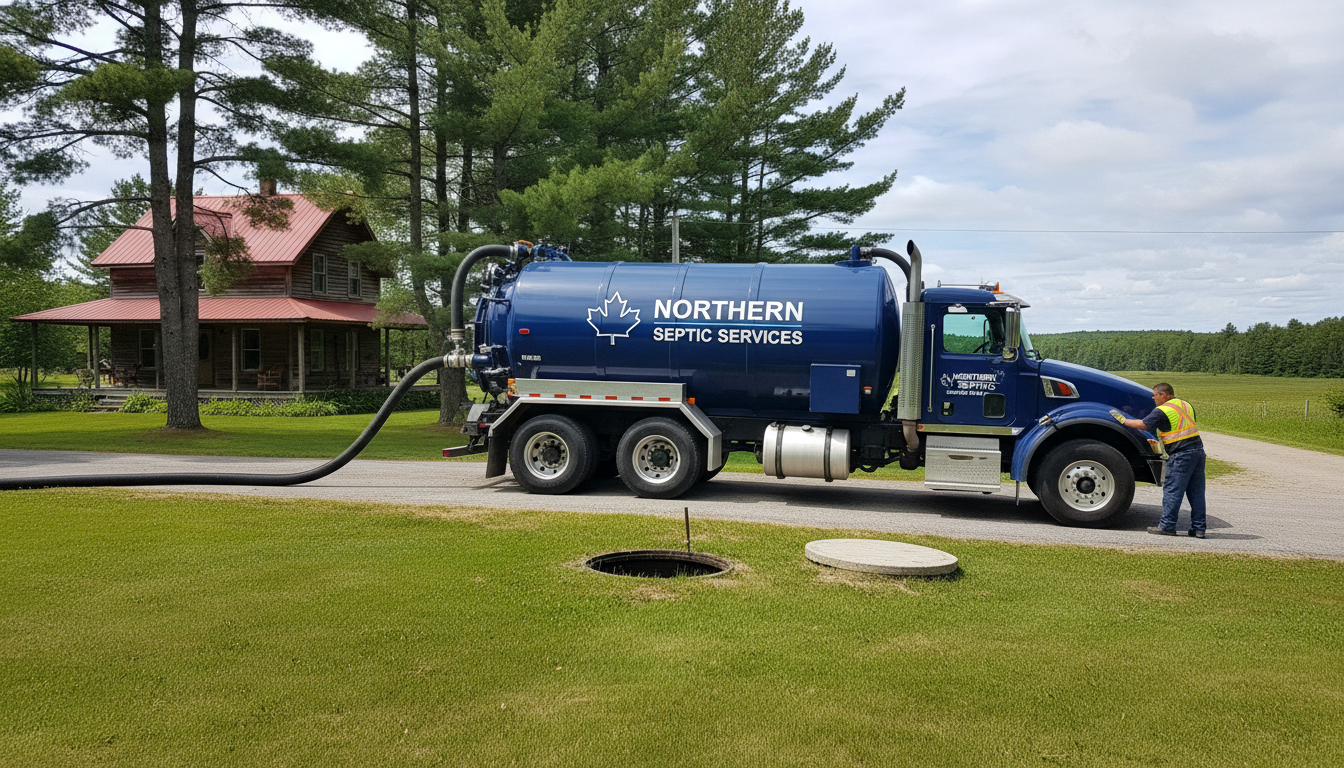
A septic pumping truck servicing a residential property near Callander — regular pumping is the single most important maintenance task.
How Often to Pump Your Septic Tank
The general rule is every 3 to 5 years, but the right interval for your home depends on your tank size, household size, and water usage. Pumping too infrequently lets solids escape to the drain field. Pumping too frequently wastes money and removes beneficial bacteria. Here's a practical guide.
Pumping Frequency by Household Size
For a standard 3,600-litre (800-gallon) tank — the most common size in the North Bay area:
- 1–2 people: Every 4–5 years
- 3–4 people: Every 3–4 years
- 5–6 people: Every 2–3 years
- 6+ people: Every 1–2 years
If your tank is larger (4,500 litres / 1,000 gallons), you can add roughly a year to each interval. If it's smaller (2,700 litres / 600 gallons), subtract a year.
What Affects Pumping Frequency
Water usage is the biggest factor. High-efficiency toilets, low-flow showerheads, and front-loading washing machines reduce the volume of water entering your tank, which extends the interval between pumpings. Conversely, leaking fixtures, running toilets, and long showers increase volume and accelerate sludge buildup.
Garbage disposals dramatically increase the solids load in your tank. If you use a garburator regularly, reduce your pumping interval by at least one year. Some septic professionals recommend against garbage disposals entirely for homes on septic systems.
Guests and seasonal changes matter too. If you host extended family over holidays or have a cottage that goes from empty to full occupancy in summer, those spikes in usage accelerate sludge buildup beyond what the averages above suggest.
A good pumping contractor will measure your sludge and scum levels at each service call and recommend when to schedule the next pumping. If they pump without measuring first, find a different contractor. The measurement tells you whether your current interval is right or needs adjusting.
6 Warning Signs of Septic Problems
Catching septic problems early can save you thousands of dollars. A full drain field replacement in the North Bay area typically costs $15,000 to $30,000 or more. Knowing these warning signs can help you avoid that scenario.
- Slow drains throughout the house. A single slow drain is usually a localized clog that drain cleaning can fix. But when multiple drains in your home are slow at the same time — kitchen sink, bathroom sink, shower, and bathtub — the problem is likely in your septic tank or the pipe running to it. The tank may be full, or the outlet baffle may be blocked.
- Sewage odour in your yard or house. If you smell rotten eggs or raw sewage near your septic tank, drain field, or inside your home near drains, something is wrong. Odour near the tank may indicate a full tank or a damaged lid seal. Odour over the drain field suggests the system is overloaded and effluent isn't being properly absorbed by the soil.
- Wet, soggy ground over the drain field. Your drain field should look like the rest of your yard. If the ground above it is consistently wet, spongy, or has standing water — especially during dry weather — the drain field is failing. Effluent is surfacing instead of being absorbed into the soil. This is a serious problem that requires immediate professional assessment.
- Unusually lush, green grass over the drain field. A stripe of grass that's noticeably greener and taller than the surrounding lawn directly over your drain field lines is a classic warning sign. It means effluent is rising close to the surface and fertilizing the grass. While the grass looks healthy, it's telling you the system below is not.
- Sewage backup into the house. This is the worst-case scenario and the one that usually prompts an emergency call. If sewage is backing up into your lowest drains — typically basement floor drains, basement toilets, or ground-floor bathtubs — call 705-482-1253 immediately. Do not use any water in the home until the problem is assessed.
- Well water contamination. If you have both a septic system and a private well, a failing septic system can contaminate your drinking water with bacteria, nitrates, and other harmful contaminants. If your well water test shows elevated coliform or nitrate levels, your septic system should be inspected as a potential source. This is a health emergency — stop drinking the water and call your local health unit and a plumber.
When to Call Immediately
Some septic issues can wait a few days. These cannot:
- Sewage backing up into your home
- Sewage surfacing in your yard (especially if children or pets have access)
- Well water test showing bacterial contamination
- Sewage odour inside your home that won't go away
Call 705-482-1253 for emergency septic system service across North Bay, Callander, and surrounding areas.

Inspecting a septic tank access riser — regular inspection helps catch problems before they become emergencies.
Septic Maintenance Do’s and Don’ts
Most septic failures are preventable. The system is designed to last decades, but only if you treat it right. Here's what helps and what hurts.
Do
- Pump on schedule. This is the single most important thing you can do. Set a reminder, keep records, and don't skip it. A $300–$500 pumping every 3–5 years prevents a $15,000–$30,000 drain field replacement.
- Conserve water. The less water you send to the tank, the better it works. Fix leaking faucets and running toilets promptly. A single running toilet can send hundreds of litres of extra water into your tank every day, overwhelming the system and flushing solids into the drain field before bacteria can break them down.
- Spread laundry loads throughout the week. Doing five or six loads of laundry in a single day sends a massive surge of water into your septic tank all at once. The tank doesn't have time to settle properly, and solids get pushed into the drain field. Spread loads across the week — one or two per day maximum.
- Keep records of pumping, inspections, and repairs. These records are invaluable when selling your property, diagnosing problems, or adjusting your maintenance schedule.
- Know where your tank and drain field are. Mark the location of your tank lid, distribution box, and drain field boundaries. This saves time and money every time a pumping truck arrives or a plumber needs to inspect the system.
Don't
- Don't flush anything except toilet paper and human waste. No wipes (even "flushable" ones), no feminine hygiene products, no dental floss, no cat litter, no medications, no condoms. These don't break down in the tank and accelerate sludge buildup.
- Don't pour grease, oil, or fat down any drain. Grease solidifies in the tank and forms a thick scum layer that can block the outlet baffle and flow into the drain field. Wipe greasy pans with paper towel before washing. Dispose of cooking oil in the garbage.
- Don't park vehicles or heavy equipment on the drain field. The weight compresses the soil and crushes the distribution pipes. Once those pipes are crushed, the entire drain field section needs to be rebuilt. This includes cars, trucks, ATVs, snowmobiles, and heavy lawn equipment.
- Don't plant trees or deep-rooted shrubs near the drain field. Tree roots will find and invade drain field pipes — it's just a matter of time. Keep trees at least 10 metres (30 feet) from the drain field. Willows and poplars are especially aggressive and should be kept even farther away. Grass is the only appropriate cover for a drain field.
- Don't use septic tank additives. Despite marketing claims, the Ontario Building Code does not recommend or require additives. Your tank already contains the bacteria it needs. Some additives can actually harm the system by disrupting the natural bacterial balance or introducing chemicals that damage the drain field soil.
- Don't connect sump pumps, foundation drains, or roof downspouts to the septic system. This floods the tank with clean water that doesn't need treatment, overwhelming the system and washing solids into the drain field.

Unusually green, lush grass growing directly over drain field lines — a classic warning sign that effluent is rising too close to the surface.
Winterizing Your Septic System
North Bay's winters create specific challenges for septic systems. Frost can penetrate 4 to 5 feet into the ground in our area, and a frozen septic component can shut down your entire system until spring. Here's how to protect it.
Let grass grow over the drain field in fall. Longer grass and leaf cover act as natural insulation. In September and October, stop mowing the grass directly over your drain field and let it grow tall. The extra vegetation traps snow, which also provides insulation. A drain field with a thick snow cover is far less likely to freeze than one that's been plowed or shoveled bare.
Don't pump your tank in late fall. This is counterintuitive, but pumping your tank in October or November — right before the deep freeze — can actually increase freeze risk. A full tank retains more heat than an empty one. The liquid and biological activity inside the tank generate warmth that helps prevent freezing. Schedule pumping for spring or summer instead.
Keep bacteria active. If your home will be occupied all winter, normal daily water usage keeps warm water flowing through the system and maintains bacterial activity that generates heat. If you're leaving a cottage or seasonal property unoccupied for winter, you have two options: either have the system professionally winterized (drained and treated with antifreeze), or arrange for someone to run water through the system periodically to keep it active.
Insulate exposed components. If your septic tank lid or riser is at or near ground level, insulate it with rigid foam board or straw bales before the first hard freeze. Inspection ports and cleanout pipes that extend above grade should also be insulated. Don't use heat cables on septic components — they can damage plastic risers and are a fire risk near methane gas.
Fix any issues before freeze-up. A slow drain, a gurgling toilet, or a soft spot in the yard that you've been ignoring all summer will become a much bigger — and much more expensive — problem once the ground freezes. Address septic issues in September or October while the ground is still accessible and repairs are straightforward.
Septic Inspections for Property Sales
If you're buying or selling a property with a septic system in the Nipissing District, a septic inspection is a critical part of the transaction. Here's what you need to know.
Nipissing District Requirements
In Ontario, the Ontario Building Code governs septic system installation and maintenance. The North Bay Parry Sound District Health Unit oversees septic compliance in our area. While a septic inspection isn't technically mandatory for every property sale, most real estate lawyers and mortgage lenders require one. If the property has a septic system, expect the buyer's lawyer to request proof that the system is functional and compliant.
Properties with known septic issues may have difficulty closing a sale. If you're selling a Callander or rural property, getting a proactive inspection before listing can prevent surprises that delay or kill a deal.
What Inspectors Check
A thorough septic inspection for a property sale typically includes:
- Tank condition: Pumping the tank and inspecting the interior for cracks, deterioration, root intrusion, and baffle condition. Both inlet and outlet baffles are checked.
- Sludge and scum levels: Measured before pumping to assess whether the system has been properly maintained.
- Distribution box: Inspected for levelness, structural integrity, and proper flow distribution to all drain field lines.
- Drain field performance: Visual inspection for surface ponding, wet spots, or odours. Some inspections include a hydraulic load test where water is run through the system to confirm the drain field can handle normal flow rates.
- Setback distances: Confirmation that the system meets required distances from wells, property lines, waterways, and structures.
- Permit verification: Confirming that the system was installed with proper permits and matches the approved design.
Cost of a Septic Inspection
A standard septic inspection in the North Bay area typically costs $300 to $600, depending on the scope and whether the tank needs to be pumped as part of the inspection (pumping is usually additional). It's money well spent. Discovering a failed drain field after closing on a property means you're responsible for a $15,000 to $30,000+ replacement that the seller should have disclosed.
If you're buying a rural property and want a septic inspection, or if you're selling and want to get ahead of buyer concerns, we can help. Our septic system services include comprehensive inspections, maintenance, and repair across the North Bay region.
Need Septic System Help?
Whether you need routine pumping, an emergency repair, a pre-sale inspection, or winterization advice, we service septic systems across North Bay, Callander, Corbeil, and surrounding areas. One call gets it handled.
Call 705-482-1253