
A home for sale in a North Bay neighbourhood — what’s hiding behind the walls matters more than the curb appeal.
Plumbing is the single most expensive hidden problem in home purchases. A standard home inspection only scratches the surface — it won’t camera the sewer line, test water pressure accurately, or identify pipe materials buried inside walls. Before you close on a North Bay home, use this 10-point plumbing checklist to catch problems that could cost you $5,000 to $15,000 or more after you move in.
Buying a home is the biggest financial decision most people make. And in North Bay’s real estate market — where a significant portion of the housing stock was built between the 1950s and 1980s — plumbing problems are one of the most common and most expensive surprises new homeowners face. The kitchen might look renovated. The bathroom might have new tile. But the pipes behind those walls could be 50 years old and ready to fail.
We’ve seen it dozens of times: a family closes on their “dream home” and within six months they’re facing a $10,000 pipe replacement bill that a proper plumbing inspection would have caught before the offer was signed. This guide gives you the exact checklist our plumbers use when evaluating a home’s plumbing system, so you know what to look for — and what to demand — before you buy.
The 10-Point Plumbing Inspection Checklist
Go through every item on this list before you finalize your home purchase. Some you can check yourself during a viewing. Others require a licensed plumber with the right equipment. Either way, don’t skip any of them.
1. Pipe Material and Age
This is the single most important thing to check. Go to the basement or crawl space and look at the visible plumbing. Copper pipes (reddish-brown metal) are the gold standard and can last 50–70 years. PEX tubing (flexible plastic, usually red and blue) is modern and reliable. ABS or PVC (black or white plastic drain pipes) are standard for waste lines. What you don’t want to find: galvanized steel (grey metal with threaded fittings), polybutylene (grey flexible plastic), or Kitec (orange or blue flexible pipe with brass fittings). We’ll cover why in the red flags section below.
2. Water Pressure Test
Turn on multiple faucets simultaneously — kitchen sink, bathroom sink, and a shower — and flush a toilet. Healthy water pressure should maintain strong flow even with multiple fixtures running. If the pressure drops dramatically, it could indicate corroded pipes restricting flow, an undersized supply line, or a failing pressure regulator. A plumber can measure exact pressure with a gauge — normal residential pressure is 40–60 PSI.
3. Drain Speed Test
Fill every sink and tub in the house, then release the drains simultaneously. They should all drain quickly and smoothly with no gurgling sounds. Slow drains in a single fixture usually mean a local clog. Slow drains throughout the house point to a main sewer line problem — which is a much bigger and more expensive issue. Listen for gurgling from other drains while one is emptying — that’s a classic sign of a venting problem or partial sewer blockage.
4. Water Heater Age and Condition
Find the water heater and check the manufacturer’s label for the installation date or serial number (which encodes the manufacture date). Tank water heaters last 8–12 years on average. If the unit is approaching or past 10 years, budget for a replacement. Look for rust at the base, signs of leaking, and check whether the pressure relief valve has a discharge pipe running to a floor drain. A water heater replacement costs $1,500–$3,000 installed — not a deal-breaker, but something you want to negotiate into the purchase price.
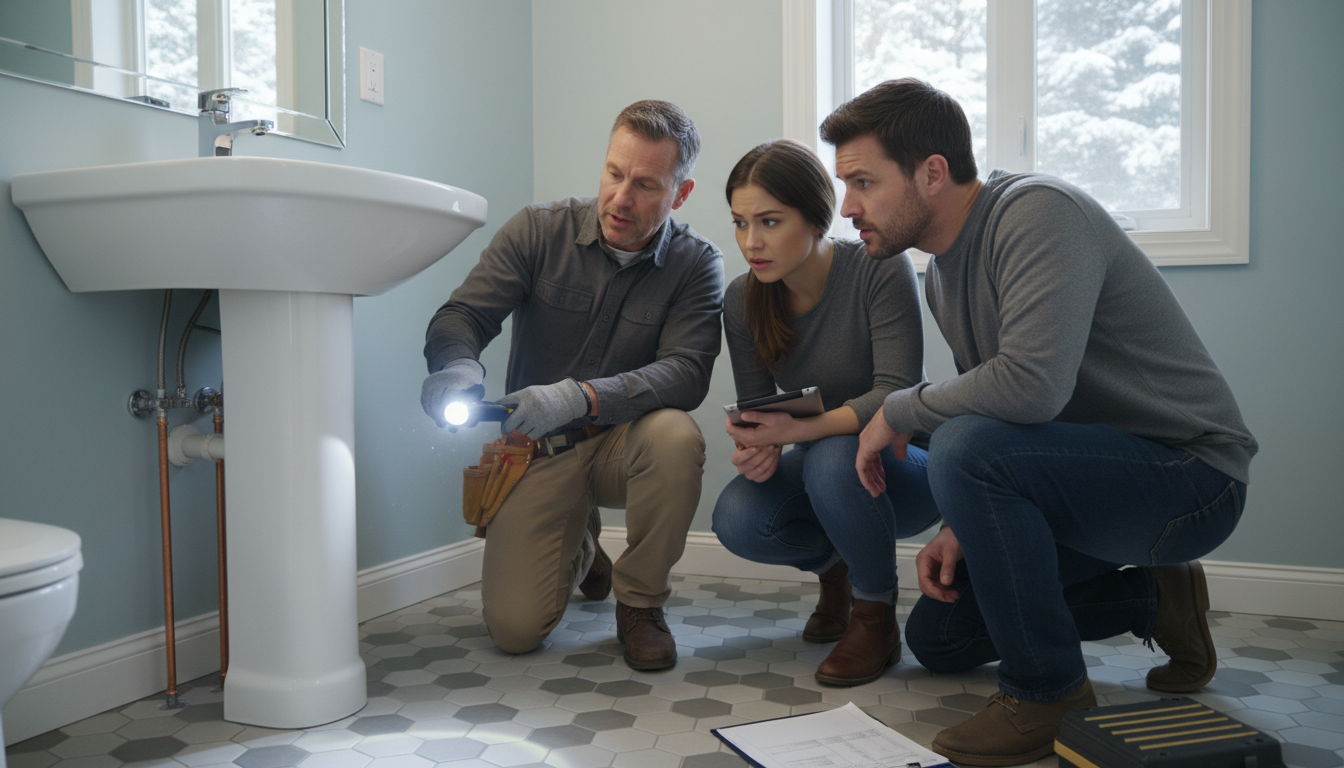
A plumbing inspection goes deeper than a standard home inspection — checking pipe materials, joints, and hidden connections.
5. Sewer Line Camera Inspection
This is the one inspection most buyers skip — and it’s the one that catches the most expensive problems. A sewer camera inspection sends a waterproof camera through the main sewer line from your house to the city connection (or septic tank). It reveals tree root intrusion, cracked or collapsed pipe sections, bellies (low spots where waste collects), and offset joints. Sewer line replacement costs $4,000–$12,000. A camera inspection costs $200–$400. The math is obvious.
6. Water Meter Leak Test
This is a simple test anyone can do. Make sure every faucet, toilet, and water-using appliance in the house is off. Then go to the water meter in the basement and watch the flow indicator (the small triangle or dial on the meter face). If it’s moving, water is flowing somewhere — meaning there’s a leak. Even a slow leak that moves the indicator can waste thousands of litres per year and indicate a hidden pipe failure inside a wall or under the slab.
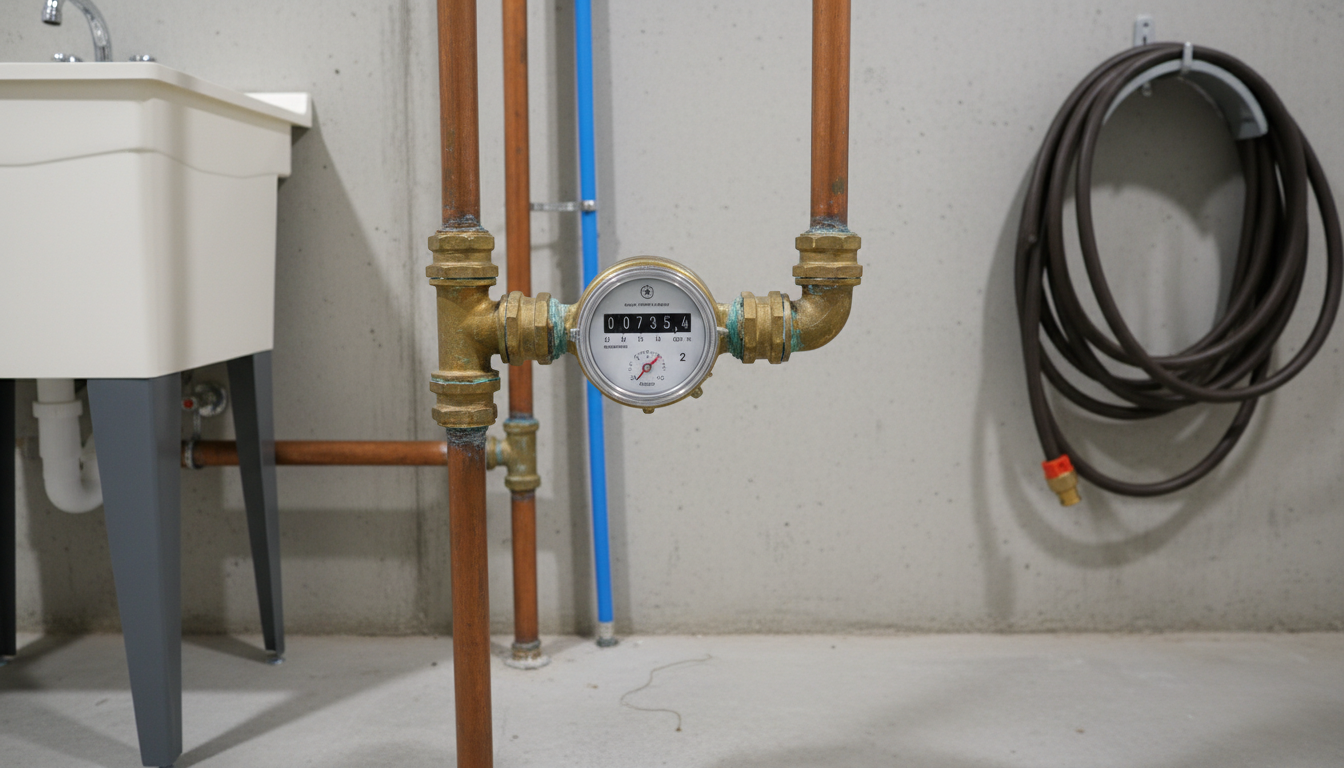
The water meter leak test — if the flow indicator moves with everything off, you’ve got a hidden leak.
7. Fixture Condition
Check every faucet, toilet, and showerhead in the house. Look for drips, stains, and corrosion around handles and connections. Test the hot and cold on every faucet. Flush every toilet and make sure it fills and stops properly — a running toilet can waste 750+ litres per day. Individual fixture replacements are relatively cheap ($100–$500 per fixture), but if every fixture in the house needs work, it adds up quickly and signals that the previous owner deferred maintenance on the entire plumbing system.
8. Shutoff Valve Function
Test the main water shutoff valve — it should turn smoothly and actually stop the water flow completely. Then check individual shutoff valves under sinks and behind toilets. Many older North Bay homes have gate valves that seize up over time. A valve that won’t close means you can’t isolate a leak in an emergency, which turns a minor problem into a major flood. Replacing seized valves is a straightforward plumbing job but one you want to know about before you buy, not during a 2 a.m. emergency.
9. Sump Pump Test
If the house has a sump pit (most North Bay basements do), check whether there’s a working sump pump installed. Pour a bucket of water into the pit — the pump should activate, pump the water out, and shut off automatically. Check the discharge line to make sure it exits the house and directs water away from the foundation. A failed sump pump during spring thaw or heavy rain can flood an entire basement in hours. Replacement costs $400–$1,200 depending on the pump type and installation complexity.
10. Well and Septic Status (Rural Properties)
If the property is outside North Bay’s municipal water and sewer service — common in Corbeil, Bonfield, Trout Lake, and rural Nipissing — you need a well water test and septic inspection. Get a water quality test for bacteria, nitrates, and hardness. Ask when the septic tank was last pumped (should be every 3–5 years). Find out the age and type of the septic system — a failed septic system replacement costs $15,000–$30,000. Have the septic bed inspected by a licensed installer before closing.
Red Flags That Should Scare You
Some plumbing problems are negotiation points. Others should make you walk away from a deal — or at minimum, demand a significant price reduction. Here are the red flags our plumbers watch for.
Walk-Away Warning Signs
- Galvanized steel pipes. These grey, threaded metal pipes were standard in homes built before 1970. They corrode from the inside out, restricting water flow and eventually leaking. If a home still has its original galvanized supply lines, full pipe replacement is not a matter of if — it’s a matter of when. Cost: $5,000–$15,000 for a full repipe.
- Polybutylene pipes (poly-B). Common in homes built between 1978 and 1995. This grey flexible plastic was a popular cheap alternative to copper, but it degrades from the inside when exposed to chlorine in municipal water. Poly-B failures are sudden and catastrophic — the pipe splits without warning. Many insurance companies in Ontario won’t cover homes with poly-B, or charge a premium.
- Kitec plumbing. Installed in Canadian homes from 1995 to 2007. Identifiable by orange (hot) and blue (cold) flexible pipes with brass fittings. The brass fittings corrode and fail, causing leaks and flooding. Kitec was the subject of a major class-action settlement. If a home has Kitec, budget $8,000–$15,000 for replacement.
- Water heater over 10 years old. Not necessarily a deal-killer, but you’re on borrowed time. Factor $1,500–$3,000 for a water heater replacement into your offer.
- Evidence of water damage. Stains on ceilings, warped flooring near bathrooms, musty smells in the basement, freshly painted basement walls (covering stains), or efflorescence (white mineral deposits) on foundation walls. These all point to past or present water intrusion that may indicate failed plumbing, poor drainage, or foundation issues.
- Low water pressure throughout the house. If multiple fixtures have weak pressure, the supply line or internal piping is likely corroded and restricting flow. This is especially common in homes with galvanized pipes.
- Sewer camera showing roots or cracks. Tree roots inside a sewer line mean the pipe has failed at one or more joints. Roots will keep growing back even after clearing. Cracked or collapsed sections require excavation and replacement — $4,000–$12,000 depending on depth and length.
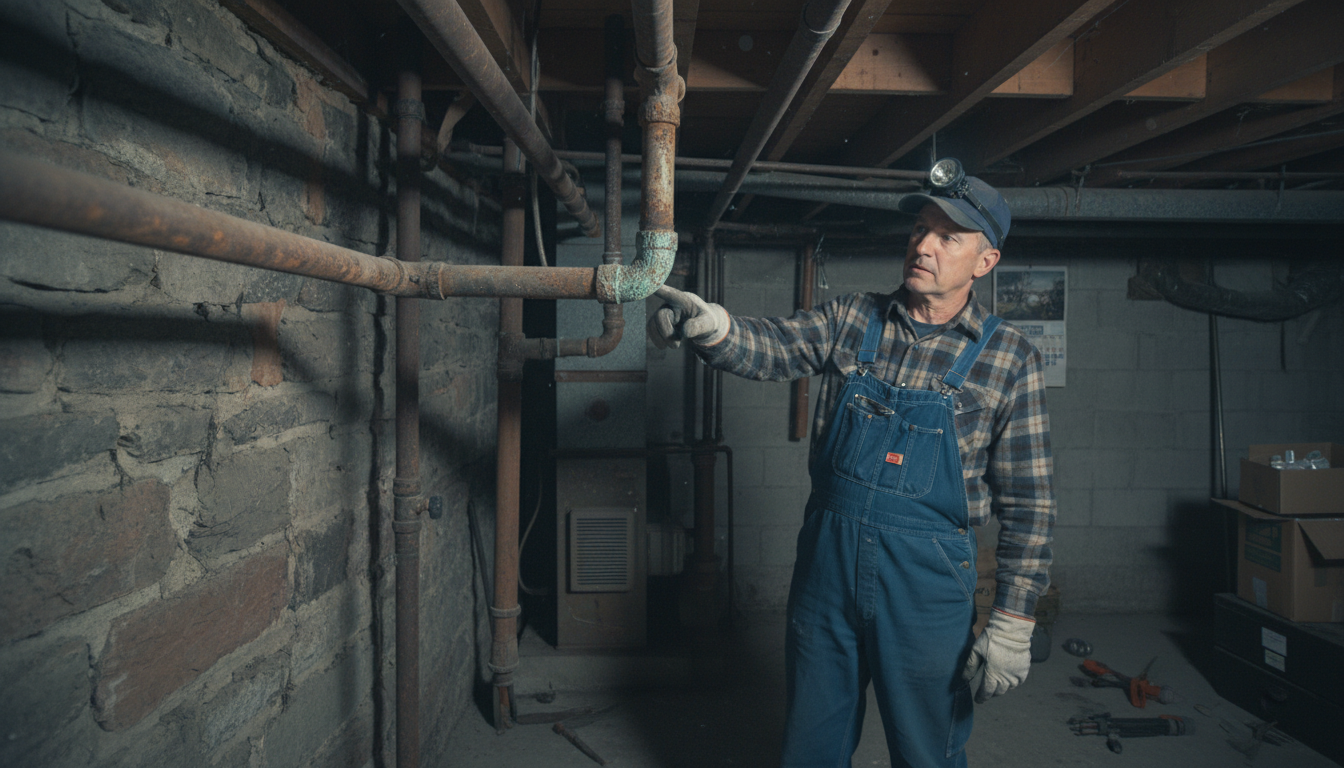
Corroded galvanized pipes from a 1960s North Bay home — the interior is almost completely blocked by decades of mineral buildup.
What’s Normal vs What’s a Problem
Not every plumbing issue is a crisis. Part of being an informed buyer is knowing the difference between cosmetic wear and structural failure. Here’s how to tell them apart.
Minor drips at faucet handles — Normal wear. Usually a $5 washer or cartridge replacement. Not a negotiation point unless every faucet in the house is dripping, which signals deferred maintenance.
Active leaks at pipe joints or under fixtures — A problem. Active leaks mean the plumbing is failing. Even a small, slow leak can cause mold growth behind walls within 48 hours. Any active leak should be repaired before closing or credited in the purchase price.
Cosmetic rust on visible pipe fittings — Surface oxidation on brass or copper fittings is normal, especially in humid basements. Wipe it off and check the joint underneath — if the metal is solid and dry, it’s fine.
Structural corrosion with flaking, pitting, or green buildup — A problem. Deep pitting on copper pipes, heavy green corrosion (verdigris), or flaking on galvanized pipes means the pipe wall is thinning. These pipes are approaching failure and should be factored into your budget.
A toilet that runs for a few extra seconds after flushing — Usually a $15 flapper valve. Normal wear. Fix it yourself on moving day.
A toilet that runs constantly or rocks on its base — A problem. Constant running wastes water and money. Rocking indicates a failed wax seal, which can leak sewage under the floor. Both need professional repair.
North Bay-Specific Concerns
Every real estate market has its own plumbing challenges. Here’s what makes North Bay unique — and what to pay extra attention to based on where in the city you’re buying.
West Ferris and Downtown homes built in the 1950s–1970s are the highest-risk properties for galvanized pipe issues. These neighbourhoods were developed during the era when galvanized steel was the standard supply pipe material. Many of these homes have never been replumbed. If you’re looking at a home in West Ferris, the south end, or downtown North Bay that was built before 1975, assume you’ll find galvanized pipes until proven otherwise. Get a plumbing inspection before you make an offer.
Rural properties need well and septic inspection — no exceptions. If you’re buying outside North Bay’s municipal services — Corbeil, Bonfield, Callander rural, Trout Lake area — the well and septic system are the two most expensive components on the property. A failed well pump is $2,000–$4,000. A failed septic system is $15,000–$30,000. Get both professionally inspected. Ask for pump test results, water quality reports, and septic pumping records. If the seller can’t produce these documents, that’s a red flag.
Waterfront and lakeside properties need sump pump verification. Properties near Lake Nipissing, Trout Lake, and other waterfront locations in the North Bay area sit on high water tables. A working sump pump isn’t optional — it’s essential. Verify the pump works, check for battery backup (power outages during spring storms are common in Northern Ontario), and look for any history of basement flooding. Water stains on basement walls at a consistent height are a telltale sign of seasonal flooding.
North Bay’s hard water takes a toll on plumbing. Municipal water in North Bay has moderate hardness levels that accelerate mineral buildup inside pipes, water heaters, and fixtures. Check the water heater for heavy scale buildup at the bottom of the tank (you can hear it — a rumbling or popping sound when the heater fires). Ask whether the home has a water softener and whether it’s been maintained.
How Much Plumbing Problems Cost to Fix
Knowing the repair costs lets you negotiate from a position of strength. Here’s what the most common plumbing problems cost to fix in North Bay (prices include parts and labour).
- Full pipe replacement (repipe) — $5,000–$15,000 depending on home size, number of fixtures, and accessibility. Copper repipe is at the high end; PEX is more affordable.
- Sewer line replacement — $4,000–$12,000 depending on depth, length, and whether the line runs under a driveway, deck, or landscaping.
- Water heater replacement — $1,500–$3,000 for a standard tank unit installed. Tankless upgrades run $3,500–$5,500.
- Sump pump replacement — $400–$1,200 including pump, check valve, and discharge line.
- Well pump replacement — $2,000–$4,000 depending on well depth and pump type.
- Septic system replacement — $15,000–$30,000 for a new tank and leaching bed.
- Individual fixture replacement — $100–$500 per fixture (faucets, toilets, etc.).
- Shutoff valve replacement — $150–$350 per valve.
Add up every item on this list that applies to the home you’re considering. That total is your negotiation leverage. If the seller won’t credit or reduce the price accordingly, you need to decide whether you’re comfortable absorbing those costs. Don’t assume you’ll “deal with it later” — plumbing problems don’t get cheaper with time. They get worse.
Should You Get a Dedicated Plumbing Inspection?
Yes — especially for any home older than 30 years. A standard home inspection covers plumbing at a surface level: the inspector runs faucets, checks for visible leaks, and looks at the water heater. But they don’t camera the sewer line, they don’t test water pressure with a gauge, they don’t identify pipe materials inside walls, and they don’t evaluate the remaining lifespan of the system.
A dedicated plumbing inspection from a licensed plumber costs $200–$500 depending on the scope. Add a sewer camera inspection for another $200–$400. That $400–$900 total investment can save you from a $10,000+ surprise. More importantly, it gives you specific, documented evidence to negotiate the purchase price.
Think of it this way: you wouldn’t buy a used car without a mechanic looking at it first. A house costs 10 to 50 times more than a car, and the plumbing system is one of the most expensive components to repair or replace. A few hundred dollars for a professional plumbing assessment is one of the smartest investments you’ll make in the home buying process.
What a Professional Plumbing Inspection Includes
- Identification of all pipe materials (supply and drain)
- Water pressure testing with a calibrated gauge
- Visual inspection of all accessible pipes, joints, and fittings
- Water heater evaluation (age, condition, safety devices)
- Shutoff valve testing (main and individual)
- Sump pump functional test
- Sewer camera inspection (optional add-on, highly recommended)
- Written report with photos, findings, and recommended repairs
Request a plumbing inspection as a condition of your offer. Any reasonable seller will agree — and if they refuse, ask yourself what they’re hiding.
Buying a Home in North Bay?
Don’t close without knowing what’s behind the walls. Our pre-purchase plumbing inspections give you the full picture — pipe condition, sewer line status, and a written report you can use to negotiate.
Call 705-482-1253