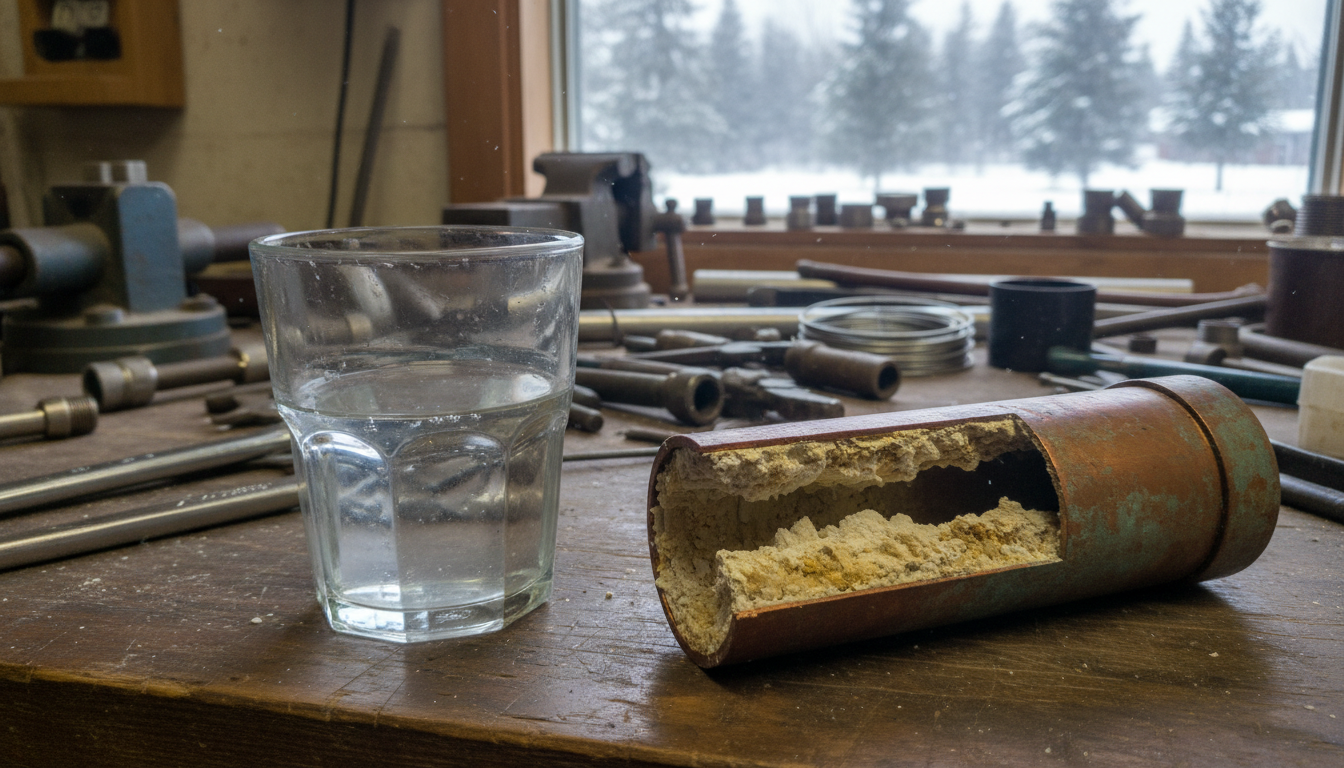
Mineral scale buildup inside a copper supply line — a common consequence of hard water in the North Bay region.
North Bay's municipal water, sourced from Lake Nipissing, measures between 120–140 mg/L of calcium carbonate — classified as moderately hard. If you're on well water in Callander, Corbeil, or rural areas surrounding North Bay, your water is significantly harder, typically ranging from 200 to 400+ mg/L. Here's what that means for your plumbing, your appliances, and what you can do about it.
Hard water is one of those issues that sneaks up on you. You don't notice it until your shower head is caked in white scale, your hot water tank is making popping sounds, or a plumber shows you the inside of a pipe that's half-blocked with mineral deposits. In the North Bay area, hard water is a fact of life — and the sooner you understand your water quality, the better you can protect your home's plumbing system.
This guide covers what hard water actually is, how North Bay's water compares to other regions, the warning signs to watch for, and the proven solutions that local homeowners are using to solve the problem for good.
How Hard Is North Bay’s Water?
North Bay's municipal water comes from Lake Nipissing, one of the largest lakes in Ontario. The city draws water from the lake through two intake pipes and treats it at the North Bay Water Treatment Plant before distributing it across the municipal system. The treatment process handles bacteria, pathogens, and turbidity — but it does not remove dissolved minerals like calcium and magnesium. Those minerals are what make water "hard."
North Bay's municipal water hardness measures approximately 120–140 mg/L (milligrams per litre) of calcium carbonate. In water hardness terms, that puts North Bay squarely in the "moderately hard" category. For reference, here's how the standard hardness scale breaks down:
- 0–60 mg/L: Soft water — minimal mineral content, easy on plumbing
- 61–120 mg/L: Slightly hard — minor scale buildup over time
- 121–180 mg/L: Moderately hard — noticeable effects on fixtures and appliances (North Bay municipal falls here)
- 181–250 mg/L: Hard — significant scale buildup, reduced appliance efficiency
- 250+ mg/L: Very hard — aggressive scaling, major plumbing impact
At 120–140 mg/L, North Bay's municipal water won't destroy your plumbing overnight. But over years, the mineral deposits accumulate inside pipes, around faucet aerators, on shower heads, and — most critically — inside your water heater. The effects are slow, steady, and expensive if you ignore them.
It's worth noting that water hardness can vary slightly by season. Spring runoff from snowmelt tends to dilute Lake Nipissing's mineral content somewhat, while late summer and fall — when lake levels drop — can produce slightly harder water. The variation is modest (typically 10–20 mg/L), but it's real.
Hard Water vs Well Water: Municipal North Bay vs Rural Areas
If you're on municipal water in North Bay, you're dealing with moderately hard water. If you're on a private well in Callander, Corbeil, Bonfield, or anywhere in the rural Nipissing District, your water is almost certainly much harder — and potentially in a different league entirely.
Well water in the North Bay region typically tests between 200 and 400+ mg/L. Some wells in the Callander corridor and areas south of North Bay have been tested at over 500 mg/L — solidly in the "very hard" category. This is because well water passes through layers of limestone, dolomite, and other calcium-rich bedrock formations that are common in the Canadian Shield and the surrounding sedimentary deposits. The deeper the well, and the more contact the water has with these rock formations, the harder it tends to be.
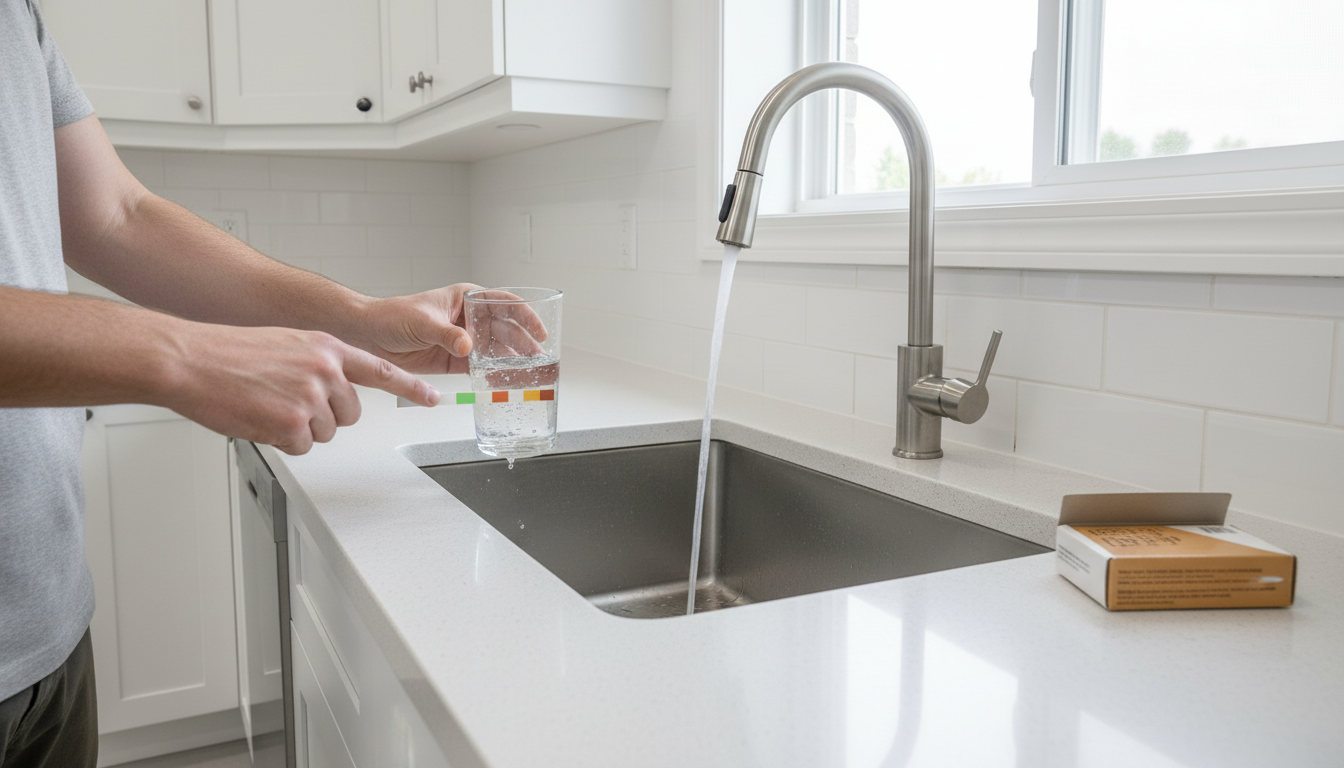
A simple test strip can tell you exactly how hard your water is — essential for well water homes in the Callander and Corbeil area.
Well water also brings additional concerns beyond hardness. Iron content is common in Nipissing District wells, which causes orange-brown staining in sinks, toilets, and laundry. Manganese can produce black staining. Sulphur bacteria create a rotten egg smell. These issues often coexist with hard water, meaning rural homeowners may need a multi-stage water filtration system rather than a simple softener alone.
Municipal vs Well Water: Quick Comparison
- North Bay municipal (Lake Nipissing): 120–140 mg/L — moderately hard. Treated for bacteria and turbidity. No iron or sulphur issues.
- Callander / Corbeil well water: 200–400+ mg/L — hard to very hard. Often contains iron, manganese, or sulphur. Requires testing and treatment.
- Rural Nipissing wells (Bonfield, Trout Lake, Powassan area): Highly variable, 150–500+ mg/L. Bedrock composition determines hardness. Always test before choosing a treatment system.
If you're on well water and haven't tested in the last two years, get a comprehensive water test done. Hardness, iron, pH, and bacteria should all be checked. Your treatment solution depends on what's actually in your water.
Signs Your Home Has a Hard Water Problem
Hard water doesn't announce itself with a dramatic plumbing failure. Instead, it shows up in a dozen small ways that most homeowners attribute to something else — cheap soap, old fixtures, or just "the way things are." Here are the signs that your water hardness is causing real problems in your home.
White or chalky deposits on faucets, shower heads, and fixtures. This is the most visible sign. Hard water leaves behind calcium carbonate scale — that white, crusty buildup you see around your faucet spouts, on shower doors, and clogging your shower head nozzles. If you're constantly scrubbing white residue off chrome fixtures, you have a hard water problem. The scale isn't just cosmetic — it's also building up inside the pipes you can't see.
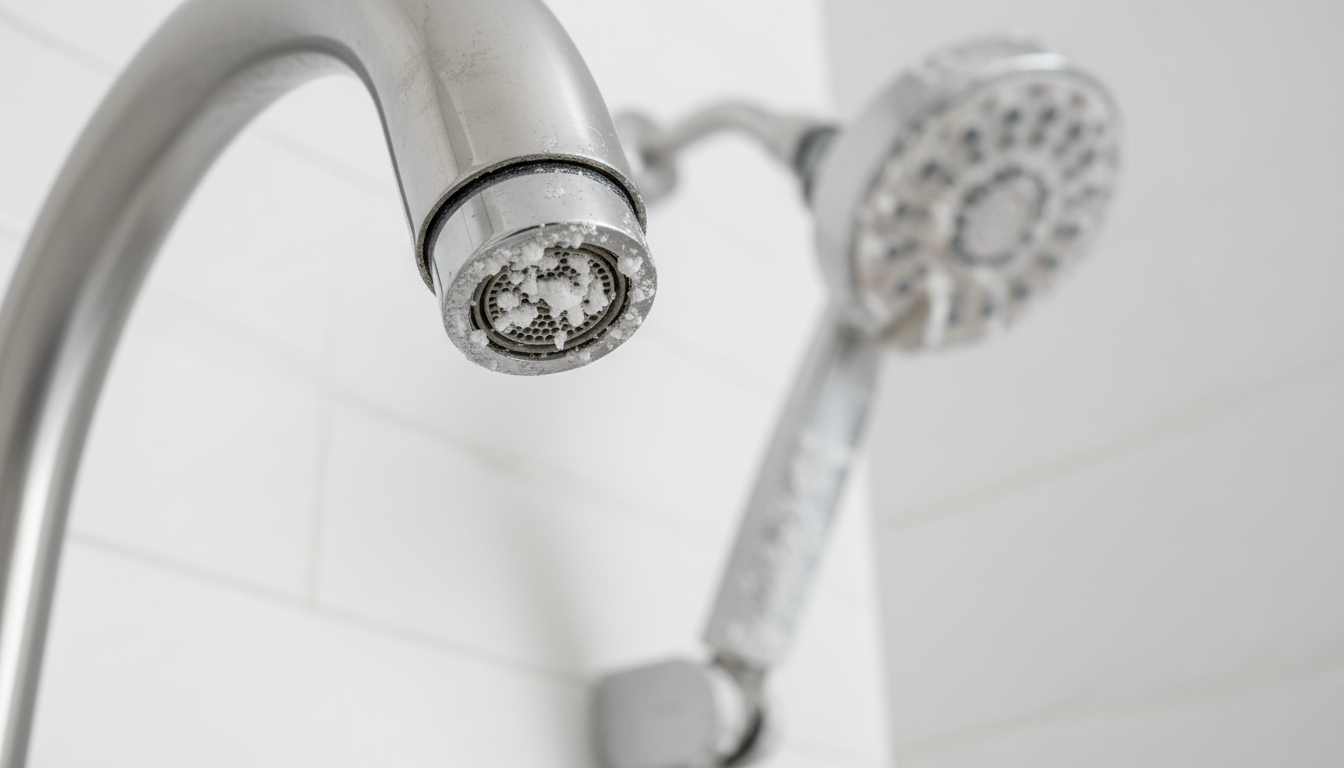
Scale deposits on a faucet aerator and shower head — the visible evidence of hard water that's also building up inside your pipes.
Soap that won't lather properly. Hard water reacts with soap to form "soap scum" instead of a lather. If you find yourself using excessive amounts of shampoo, body wash, or dish soap to get any suds, hard water is the culprit. You'll also notice a filmy residue on your skin after showering — that's soap scum, and it can clog pores and irritate sensitive skin.
Spotty, cloudy dishes and glassware. If your glasses come out of the dishwasher with white spots or a cloudy film, it's not your dishwasher or your detergent — it's hard water mineral deposits. Commercial rinse aids help mask the problem, but they don't solve the underlying water quality issue.
Dry, itchy skin and dull, brittle hair. The mineral content in hard water strips natural oils from your skin and hair. Many North Bay residents who switch to softened water report an immediate improvement in skin hydration and hair texture. If you or your family members deal with chronic dry skin or eczema that doesn't respond well to moisturizers, your water quality may be a contributing factor.
Laundry that feels stiff, looks dingy, or wears out fast. Hard water prevents detergent from dissolving and rinsing properly. Clothes washed in hard water retain mineral residue that makes fabrics feel rough and stiff. Over time, whites turn grey, colours fade faster, and the mineral buildup weakens fabric fibres, shortening the lifespan of your clothing.
Your water heater makes popping or rumbling sounds. This is the most expensive sign to ignore. Hard water minerals settle at the bottom of your water heater tank and form a layer of sediment. When the burner heats the water, it has to heat through that sediment layer first — causing the popping and rumbling sounds as water boils beneath the scale. This dramatically reduces your water heater's efficiency and can shorten its lifespan by 3–5 years.
What Hard Water Does to Your Plumbing
The cosmetic annoyances of hard water — spotty dishes, dry skin, scummy faucets — are frustrating but manageable. The real damage happens inside your plumbing system, where you can't see it until something fails.
Pipe buildup reduces water flow over time. Mineral scale accumulates on the interior walls of your pipes, gradually narrowing the opening that water flows through. A half-inch supply line that's been accumulating scale for 15–20 years can be effectively reduced to a quarter-inch opening. The result is noticeably reduced water pressure at your fixtures — weak showers, slow-filling toilets, and faucets that don't deliver the flow they used to.
Water heater sediment buildup is the most costly consequence. Your water heater is the single most affected appliance in your home. In a standard tank water heater, hard water minerals precipitate out of the water as it's heated and settle to the bottom of the tank. Over time, this sediment layer grows thicker. The consequences are significant:
- Reduced efficiency: The burner has to heat through inches of sediment before it heats the water. Gas and electricity consumption rises. A water heater with significant sediment buildup can use 25–30% more energy than a clean one.
- Shortened lifespan: The sediment layer causes localized overheating at the bottom of the tank, which accelerates tank corrosion and can cause premature failure. A water heater that should last 10–12 years may fail at 6–8 years in a hard water home without proper maintenance.
- Reduced hot water capacity: The sediment displaces water in the tank. A 50-gallon tank with 5 gallons of sediment is effectively a 45-gallon tank. You get less hot water per cycle.
- Tank failure and flooding: In severe cases, the overheating caused by sediment buildup can crack the tank lining, leading to a catastrophic leak. A 50-gallon water heater failing in your basement is a flood emergency.
Fixture valves and cartridges fail prematurely. The internal components of your faucets, shower valves, and toilet fill valves are precision-machined parts that rely on smooth surfaces and tight seals. Hard water deposits build up on these components, causing dripping faucets, leaking valves, and fill valves that won't shut off properly. Replacing fixture cartridges and valves every few years is a direct cost of untreated hard water.
Dishwashers and washing machines are affected too. Hard water scale builds up on heating elements, spray arms, and internal hoses in your dishwasher and washing machine. These appliances have shorter lifespans and higher repair rates in hard water homes. The mineral deposits also reduce cleaning effectiveness, creating a cycle of using more detergent (which still doesn't work properly) and running longer cycles (which uses more energy).
Solutions for North Bay Homeowners
The good news is that hard water is a solved problem. There are multiple treatment options available, and the right choice depends on your water source, hardness level, and what you're trying to accomplish.
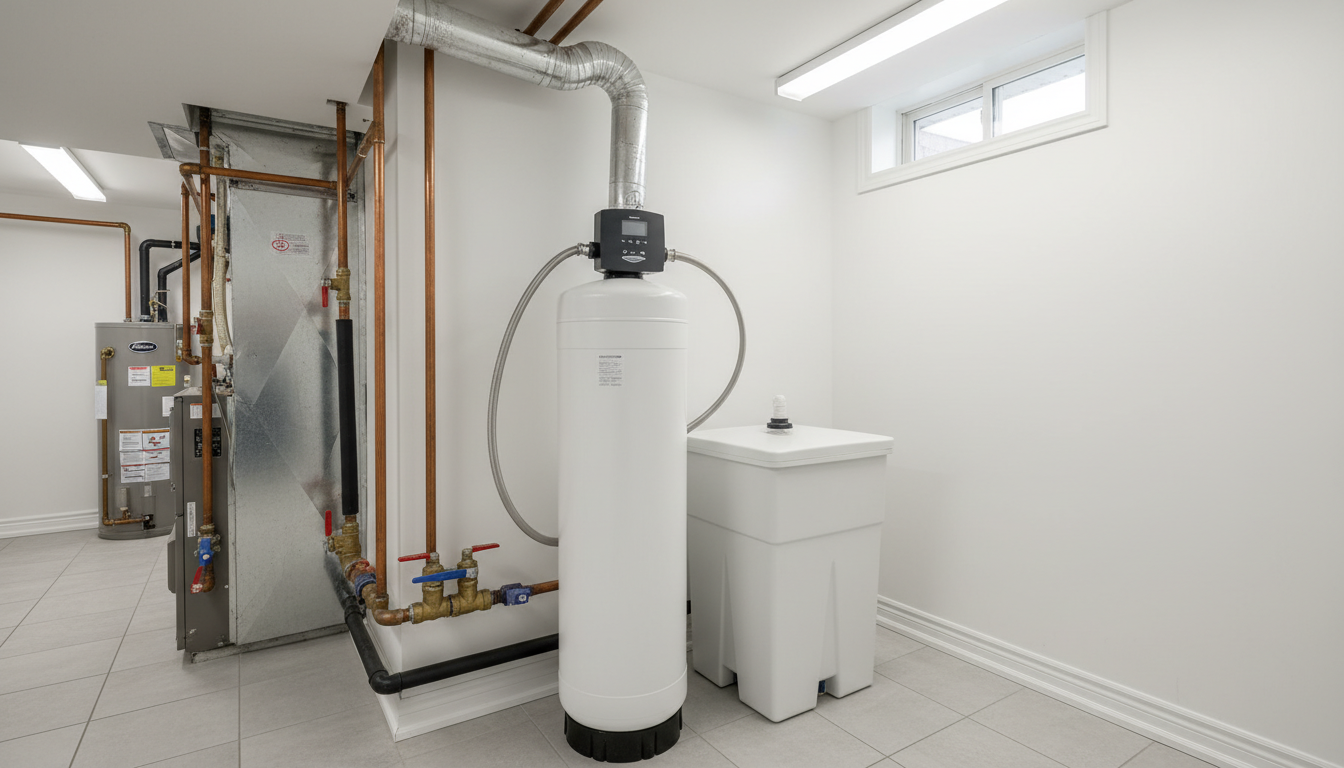
A professionally installed water softener system — the most effective solution for hard water in North Bay homes.
Water Softeners
A water softener is the gold standard solution for hard water. It works through a process called ion exchange: hard water passes through a resin bed that swaps calcium and magnesium ions for sodium ions. The result is soft water throughout your entire home — every faucet, every shower, every appliance.
For North Bay municipal water (120–140 mg/L), a standard residential water softener is more than adequate. A properly sized unit for a 3–4 person household typically costs $1,500–$3,000 installed, including the softener, bypass valve, drain connection, and setup. Salt costs run approximately $100–$150 per year.
For well water homes in Callander and rural areas (200–400+ mg/L), you'll need a higher-capacity softener and may need pre-treatment for iron, manganese, or sulphur before the water reaches the softener. Iron content above 1–2 mg/L can foul softener resin over time, reducing its effectiveness and lifespan. A plumber experienced with rural water systems can test your water and recommend the right configuration.
Whole-Home Water Filtration
For well water homes dealing with multiple water quality issues — hardness plus iron, sulphur, sediment, or bacteria — a whole-home water filtration system is often the best approach. These multi-stage systems typically include sediment filtration, iron/manganese removal, water softening, and sometimes UV disinfection for bacterial safety. Total system cost ranges from $3,000–$6,000 installed, depending on complexity.
Descaling and Maintenance
If you're not ready to install a full softener system, there are interim steps that protect your plumbing and appliances. Annual water heater flushing removes accumulated sediment and extends your tank's lifespan by years. We recommend flushing your water heater at least once per year in the North Bay area — twice per year if you're on well water with hardness above 250 mg/L.
Vinegar descaling of shower heads, faucet aerators, and dishwasher components can remove existing scale buildup. Soaking affected parts in white vinegar for 2–4 hours dissolves most calcium carbonate deposits. It's a maintenance task, not a solution — the scale will return — but it keeps fixtures functional between more permanent treatment.
Point-of-use filters on kitchen faucets or shower heads can reduce hardness at specific fixtures without treating the whole home. These are a reasonable option for renters or homeowners who aren't ready for a whole-home system. They won't protect your water heater or other plumbing, but they'll improve the water you drink and bathe in.
When to Call a Plumber
Some hard water effects are cosmetic annoyances you can manage on your own. Others are signs of plumbing damage that need professional attention. Call a plumber if you notice any of these:
- Noticeably reduced water pressure at multiple fixtures. If flow has gradually decreased over months or years, mineral buildup inside your pipes may be restricting water flow. A plumber can assess whether water pressure restoration is possible through descaling, or whether affected pipe sections need replacement.
- Discoloured water — especially brown, orange, or rust-coloured. Discoloured water can indicate corroded galvanized pipes (common in older North Bay homes), failing water heater anodes, or well water iron issues. A plumber can identify the source and recommend the right fix.
- Water heater popping, rumbling, or producing less hot water. These are signs of significant sediment buildup in your water heater tank. A professional flush may solve the problem, but if the tank has been neglected for years, the sediment can harden into a layer that's difficult to remove. In some cases, water heater replacement is more cost-effective than trying to rehabilitate a heavily scaled unit.
- Recurring leaky faucets or failing fixture valves. If you're replacing faucet cartridges or toilet fill valves every year or two, hard water scale is likely destroying the internal components. A plumber can confirm the cause and discuss whole-home water treatment to stop the cycle.
- You want to install a water softener or filtration system. Water softener installation requires connection to your main water line, a drain line for backwash, an electrical outlet for the timer, and proper sizing based on your household water usage and hardness level. It's not a DIY job — incorrect installation can cause water damage, cross-contamination, or system failure. A licensed plumber ensures it's done right the first time.
If you're on well water and haven't had a water quality test in the last two years, that's also a good reason to call. Water quality can change over time as ground conditions shift, and your treatment system needs to match what's actually in your water today — not what was in it five years ago.
For any water quality concern — hard water, discolouration, pressure issues, or water treatment system installation — call 705-482-1253. We serve North Bay, Callander, and the entire Nipissing District.
Ready to Fix Your Hard Water?
Whether you need a water softener installed, your water heater flushed, or a complete water treatment system for your well water home, we're here to help. One call gets it handled.
Call 705-482-1253