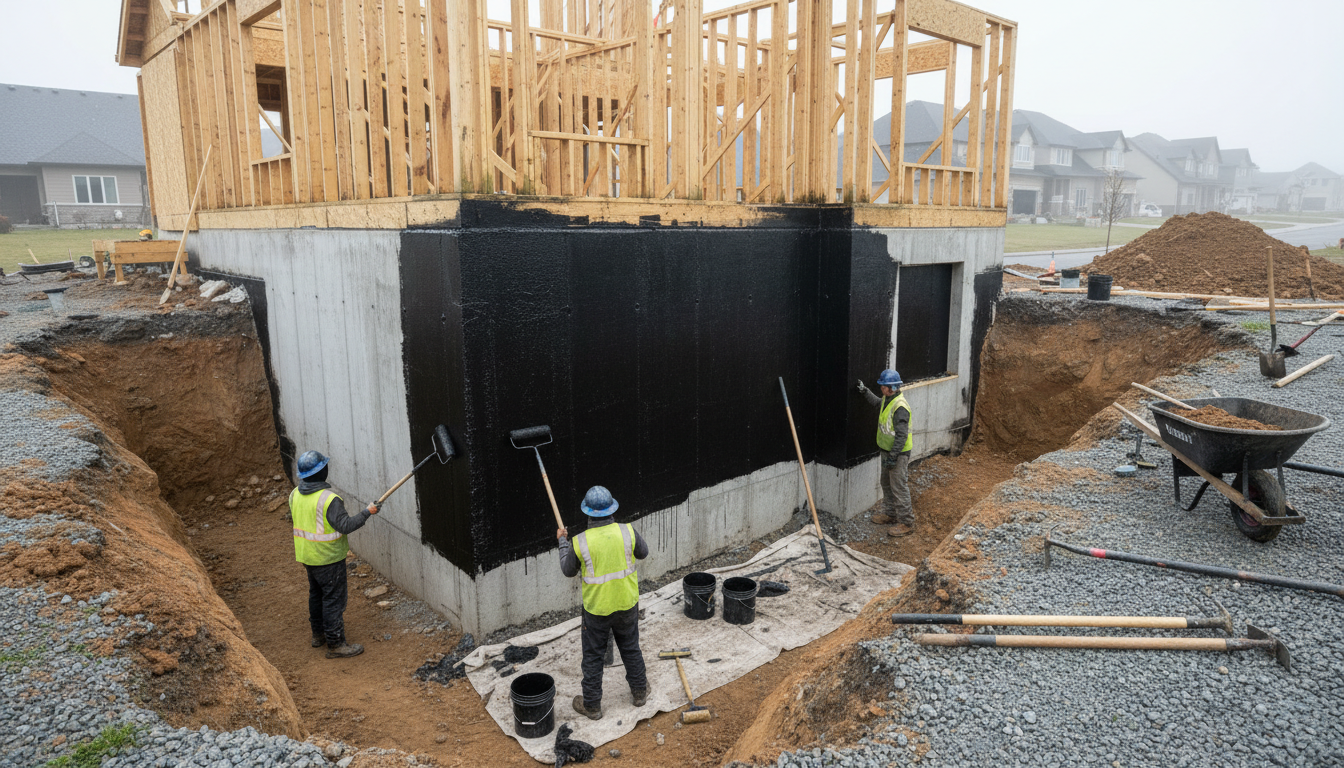
Exterior foundation waterproofing being applied to a North Bay home — the most permanent solution for basement water problems.
If you own a home in North Bay, there's a good chance you've dealt with a wet basement. Spring snowmelt, high water tables, and aging foundations make basement waterproofing one of the most common — and most important — home repairs in Northern Ontario.
A wet basement isn't just an inconvenience — it's a threat to your foundation, your indoor air quality, and your home's value. Water intrusion leads to mould growth, structural damage, and can render an entire level of your home unusable. The good news: basement waterproofing technology has come a long way, and there are proven solutions for every budget and every type of water problem common to the North Bay area.
This guide covers why North Bay basements get wet, the different waterproofing methods available, what they cost, and how to choose the right approach for your home.
Why North Bay Basements Get Wet
Understanding why your basement leaks is the first step toward fixing it permanently. North Bay's geography, climate, and building history create a unique combination of factors that make basement water problems extremely common in the Nipissing District.
Spring snowmelt overwhelms drainage systems every March and April. Northern Ontario gets 200+ centimetres of snow each winter. When that snowpack melts over a 4–6 week window in spring, the volume of water entering the soil around your foundation is enormous. The ground is often still frozen beneath the surface, so meltwater can't percolate down — it flows laterally, directly into foundation walls and floor joints. This is why most basement flooding in North Bay happens between mid-March and late April.
Lake Nipissing's water table keeps the ground saturated. North Bay sits on the shore of Lake Nipissing, and the water table throughout the city — especially in low-lying areas near the waterfront, in Callander, and along Trout Lake — is naturally high. When the water table rises during spring melt or heavy rain events, hydrostatic pressure pushes water up through basement floor cracks and the joint where the floor meets the foundation wall (called the cove joint). You can't fight the water table with sealant alone — you need a drainage system.
Clay-heavy soil traps water against foundations. Much of the soil in the North Bay area is clay-based, which drains poorly. Instead of water flowing away from your foundation, clay soil holds it right against the walls. Over time, this constant moisture saturates the concrete, and water finds its way through cracks, pores, and the cove joint. Homes built on clay soil are significantly more likely to experience chronic basement moisture problems.
Aging foundations in West Ferris and Downtown have deteriorated over decades. Many homes in West Ferris, downtown North Bay, and the south end were built in the 1940s through 1970s with poured concrete or concrete block foundations. After 50–80 years of freeze-thaw cycles, these foundations have developed cracks, spalling, and deteriorated mortar joints. Original waterproofing membranes (if any were applied) have long since broken down. These older neighbourhoods account for a disproportionate share of basement water calls.
Hydrostatic pressure is relentless. When water saturates the soil around your foundation, it exerts hydrostatic pressure — the force of water pushing against your basement walls and floor. A cubic foot of water weighs 62 pounds. Multiply that across your entire foundation perimeter and floor area, and you're dealing with thousands of pounds of pressure. Concrete is porous. Given enough pressure and enough time, water always finds a way in.
Interior vs Exterior Waterproofing
There are two fundamental approaches to basement waterproofing: managing water from the inside or stopping it from the outside. Each has its place, and the right choice depends on your specific situation, budget, and how the water is entering your basement.
Interior Waterproofing
Interior waterproofing manages water that has already entered or is about to enter your basement. The most common interior method is an interior French drain (also called a weeping tile or perimeter drain) installed along the inside edge of your basement floor, connected to a sump pump. Interior systems may also include vapour barriers on walls, interior drainage boards, and dehumidification.
Pros: Less expensive than exterior methods ($3,000–$8,000 typical). Can be installed year-round regardless of weather. No excavation around the outside of your home, so landscaping, decks, driveways, and walkways are undisturbed. Installation is faster — typically 2–4 days.
Cons: Doesn't stop water from contacting the foundation — it manages water after it enters. Doesn't address exterior foundation cracks or deterioration. The foundation walls remain wet, which can contribute to long-term deterioration.
Best for: Hydrostatic pressure issues (water coming up through the floor or cove joint), homes where exterior excavation is impractical, budget-conscious homeowners who need an effective solution now.
Exterior Waterproofing
Exterior waterproofing stops water before it reaches the foundation wall. The process involves excavating around the foundation down to the footing, repairing any cracks, applying a waterproof membrane (usually rubberized asphalt or dimpled membrane), installing new exterior weeping tile, and backfilling with gravel for drainage.
Pros: The most permanent and comprehensive solution. Stops water at the source. Protects and extends the life of the foundation. Addresses both water intrusion and foundation deterioration.
Cons: Significantly more expensive ($8,000–$20,000+ depending on home size and accessibility). Requires excavation around the foundation, which can disturb landscaping, walkways, decks, and utilities. Can only be done in warmer months when the ground isn't frozen. Takes 5–10 days depending on complexity.
Best for: Homes with visible exterior foundation cracks, deteriorating foundation walls, serious water penetration through walls (not just the floor), and homeowners who want the most permanent solution regardless of cost.
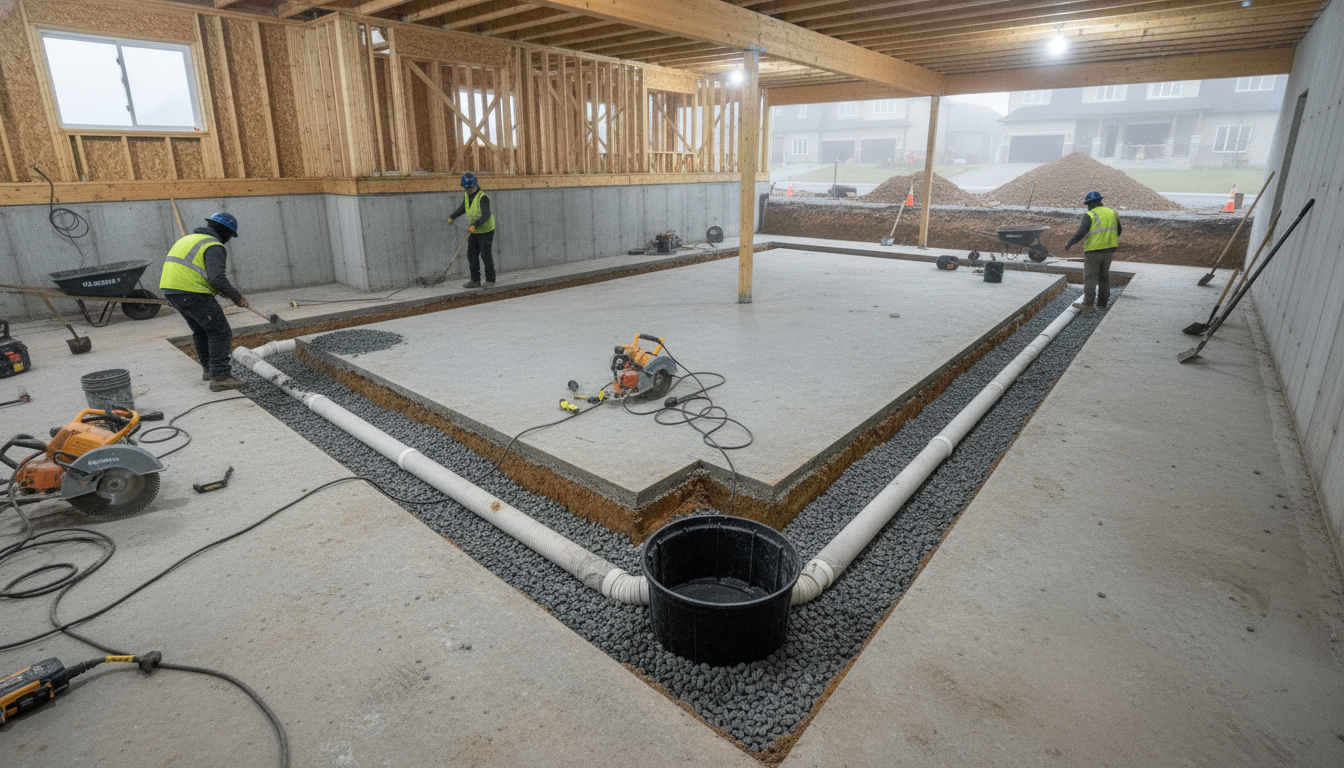
Interior French drain being installed along the basement perimeter — the most common waterproofing solution in North Bay homes.
French Drains — Interior and Exterior
French drains are the backbone of most basement waterproofing systems in North Bay. Whether installed inside or outside, the principle is the same: intercept water before it can pool on your basement floor and redirect it to a sump pump or drainage outlet.
How Interior French Drains Work
An interior French drain is installed by cutting a trench along the inside perimeter of your basement floor, typically 12–18 inches wide and deep enough to reach the base of the footing. A perforated drain pipe is laid in gravel at the bottom of the trench, sloped toward a sump pit. As water seeps through the cove joint or up through the floor, it falls into the gravel and is captured by the drain pipe before it can pool on the floor. The pipe carries the water to the sump pump, which ejects it away from the foundation.
How Exterior French Drains Work
Exterior French drains (weeping tile) are installed at the footing level on the outside of the foundation. The process requires excavating down to the footing, laying perforated pipe in a gravel bed, and covering it with filter fabric to prevent clogging. Water is intercepted before it can reach the foundation wall and is directed to a sump pump, storm drain, or daylight outlet. Most homes built before the 1980s in North Bay either never had exterior weeping tile or had clay tile that has since collapsed or clogged.
Installation Process
For an interior French drain, the process typically takes 2–4 days. The crew cuts a channel in the concrete floor using a concrete saw, excavates the trench, lays gravel and perforated pipe, installs the sump pit and pump, and then patches the concrete floor. The disruption is contained to the basement interior.
For an exterior French drain, the crew excavates around the foundation to the footing level (6–8 feet deep for most North Bay homes), installs the drain pipe and gravel, applies waterproofing membrane to the foundation wall while it's exposed, and backfills. This is a major excavation project that typically takes 5–10 days.
Cost in North Bay
Interior French drain systems in North Bay typically cost $3,000–$8,000 depending on the linear footage of drain, accessibility, and whether a new sump pump is included. Exterior French drains run $8,000–$20,000 because of the excavation involved. For many North Bay homeowners, an interior French drain with a quality sump pump provides excellent protection at a fraction of the exterior cost. French drains are the most common basement waterproofing solution we install in the Nipissing District.
Sump Pumps — Your Last Line of Defence
Every waterproofing system needs somewhere to send the water it collects. That's the sump pump's job. It's the engine that drives your entire waterproofing system, and in North Bay, it's one of the most important pieces of equipment in your home.
Primary Sump Pump
A primary sump pump sits in a sump pit (basin) recessed into your basement floor, typically at the lowest point. Water from French drains, weeping tile, or natural ground seepage collects in the pit. When the water level rises to a set point, the pump activates and ejects the water through a discharge pipe to the exterior, well away from the foundation. Quality primary pumps move 2,000–3,000+ gallons per hour and are rated for continuous operation during heavy water events.
Battery Backup — Critical for North Bay
Why Battery Backup Isn't Optional in Northern Ontario
Power outages in North Bay are common during spring storms — exactly when your sump pump is working hardest. A primary pump without battery backup is useless during an outage. We've seen basements flood with 6+ inches of water in under 2 hours during spring melt when the power went out and there was no backup pump.
- Battery backup pumps activate automatically when the primary pump loses power or can't keep up with water volume.
- Run time on a quality battery backup is 8–12 hours of intermittent pumping — enough to get through most outages.
- Water-powered backup pumps are another option for homes with municipal water — they use water pressure to operate and never need a battery, but they use a significant amount of water.
If you have a sump pump without battery backup, you're one power outage away from a flooded basement. Call 705-482-1253 to add backup protection.
Maintenance Schedule
A sump pump is a mechanical device, and it needs regular maintenance to stay reliable. We recommend testing your sump pump every 3 months by pouring water into the pit until the float activates. Check the discharge pipe for blockages or ice buildup (critical in North Bay winters). Clean the pit of debris annually. Replace the battery in battery backup systems every 2–3 years. Most quality sump pumps last 7–10 years before needing replacement. Don't wait for failure — a proactive replacement at the 8-year mark is far cheaper than emergency flood cleanup.
Cost
Sump pump installation in North Bay typically costs $800–$2,000 depending on the pump type, pit size, and whether a battery backup is included. A primary pump alone runs $800–$1,200 installed. Adding a battery backup system brings the total to $1,500–$2,000. Given that a single basement flood can cause $10,000–$50,000 in damage, a quality sump pump with backup is one of the best investments a North Bay homeowner can make.
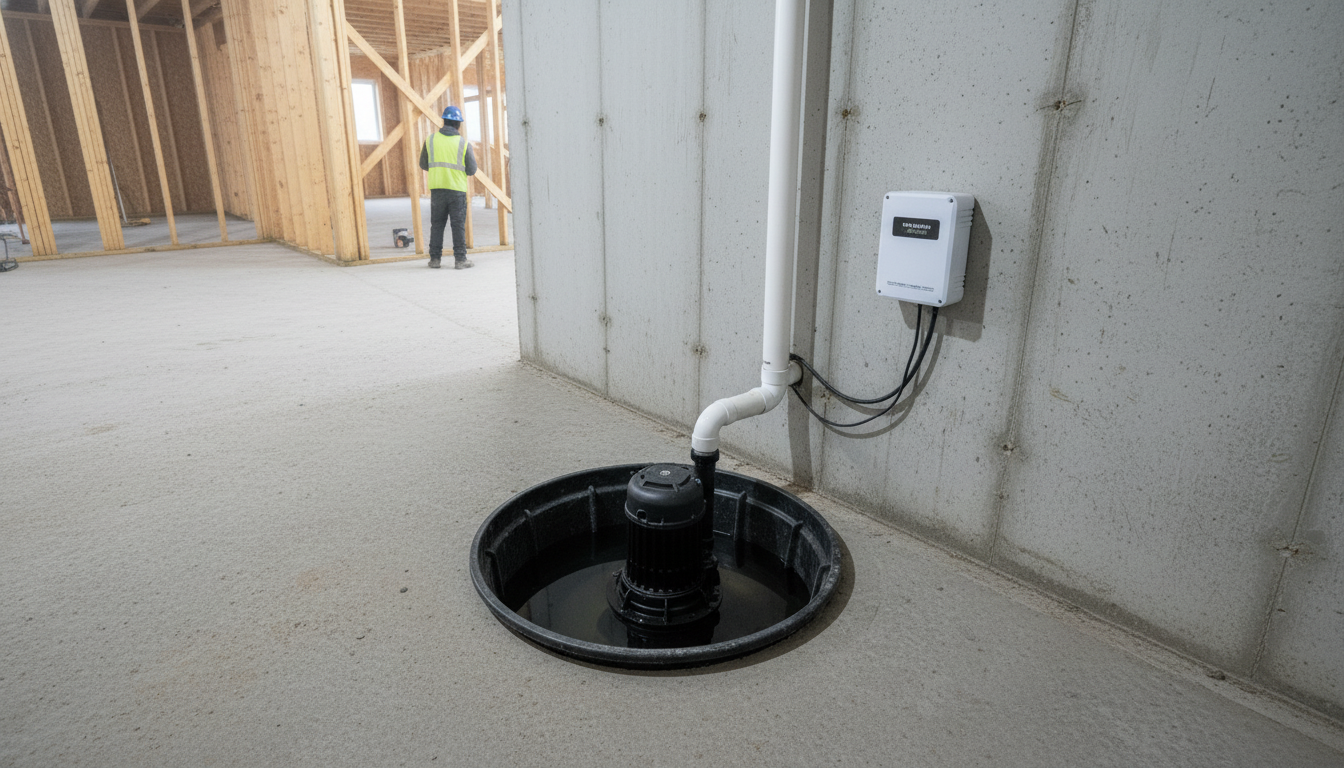
A quality sump pump with battery backup installed in a North Bay basement — your last line of defence against flooding.
What About Waterproofing Coatings?
Walk into any hardware store and you'll find shelves of basement waterproofing paints and sealants. They have their place, but it's important to understand what they can and can't do.
Interior Sealants
What they are: Crystalline waterproofing compounds (like Xypex or Krystol) or hydraulic cement that are applied to the interior surface of basement walls. Some penetrate into the concrete and form crystals that block water pathways. Others create a surface barrier.
When they help: Minor dampness and humidity coming through poured concrete walls. Surface condensation issues. As a complement to a French drain system (not a replacement). Sealing minor non-structural hairline cracks.
When they're not enough: Active water leaks. Hydrostatic pressure from a high water table. Structural foundation cracks wider than 1/8 inch. Water entering through the cove joint (floor-wall connection). Any situation where the volume of water is more than surface dampness. If you can see water flowing, dripping, or pooling, sealant alone won't solve the problem.
Exterior Membranes
What they are: Rubberized asphalt membranes, liquid-applied coatings, or dimpled drainage boards applied to the exterior face of the foundation wall. These create a continuous waterproof barrier between the soil and the concrete.
When they help: Exterior membranes are the gold standard for keeping water away from the foundation. They're applied during exterior waterproofing projects when the foundation is already excavated. They're especially effective when combined with exterior weeping tile and proper grading.
When they're not enough: Exterior membranes won't help with hydrostatic pressure coming up through the basement floor — that requires a drainage system. They also can't fix water problems caused by poor stormwater drainage, clogged gutters, or grading that directs surface water toward the foundation.
How Much Does Basement Waterproofing Cost in North Bay?
Here's a realistic breakdown of what basement waterproofing costs in the North Bay area as of 2026. Prices vary based on the size of your home, soil conditions, accessibility, and the severity of the water problem.
- Interior French drain system: $3,000–$8,000. This includes trenching, perforated pipe, gravel, sump pit, primary sump pump, and concrete patching. The most common solution for North Bay basements. Covers full perimeter or partial perimeter depending on where water is entering.
- Exterior foundation waterproofing: $8,000–$20,000+. Includes excavation to footing, foundation repair, waterproof membrane application, new exterior weeping tile, gravel backfill, and landscape restoration. Cost depends heavily on house size, foundation depth, and what's in the way (decks, walkways, gardens).
- Sump pump installation: $800–$2,000. Primary pump alone is $800–$1,200. With battery backup: $1,500–$2,000. Replacement of an existing pump is typically $600–$1,000.
- Combination systems: $5,000–$12,000. Many North Bay homes benefit from an interior French drain plus a quality sump pump with battery backup plus a backwater valve. This combination addresses hydrostatic pressure, surface water, and sewer backup in one project.
- Interior sealant/coating only: $500–$2,000 for DIY or professional application. Only appropriate for minor dampness, not active leaks.
- Crack injection (epoxy or polyurethane): $300–$800 per crack. A targeted fix for individual foundation cracks that are leaking. Effective for isolated cracks but doesn't address broader water pressure issues.
Insurance and Waterproofing
Most home insurance policies in Ontario do not cover gradual water seepage or basement waterproofing as a maintenance item. However, many policies now offer optional overland water and sewer backup endorsements that cover sudden flooding events. Installing a sump pump with battery backup and a backwater valve may qualify you for insurance premium discounts — check with your insurer. The cost of waterproofing is almost always less than the deductible and premium increases from a single flood claim.
The best approach is to get a professional assessment. Every basement is different, and a qualified waterproofing contractor can identify exactly where the water is coming from and recommend the most cost-effective solution. In many cases, a targeted approach (partial French drain + sump pump) solves the problem at a fraction of the cost of a full perimeter system.
Don't wait until spring melt to address a wet basement. The best time to waterproof is before the water shows up. If your basement has leaked in the past, it will leak again — the water table and snowmelt don't take years off.
Need Help With a Wet Basement?
Whether you need an emergency repair right now or want to waterproof before spring melt, we're here to help. Free assessments. Honest recommendations. One call gets it handled.
Call 705-482-1253