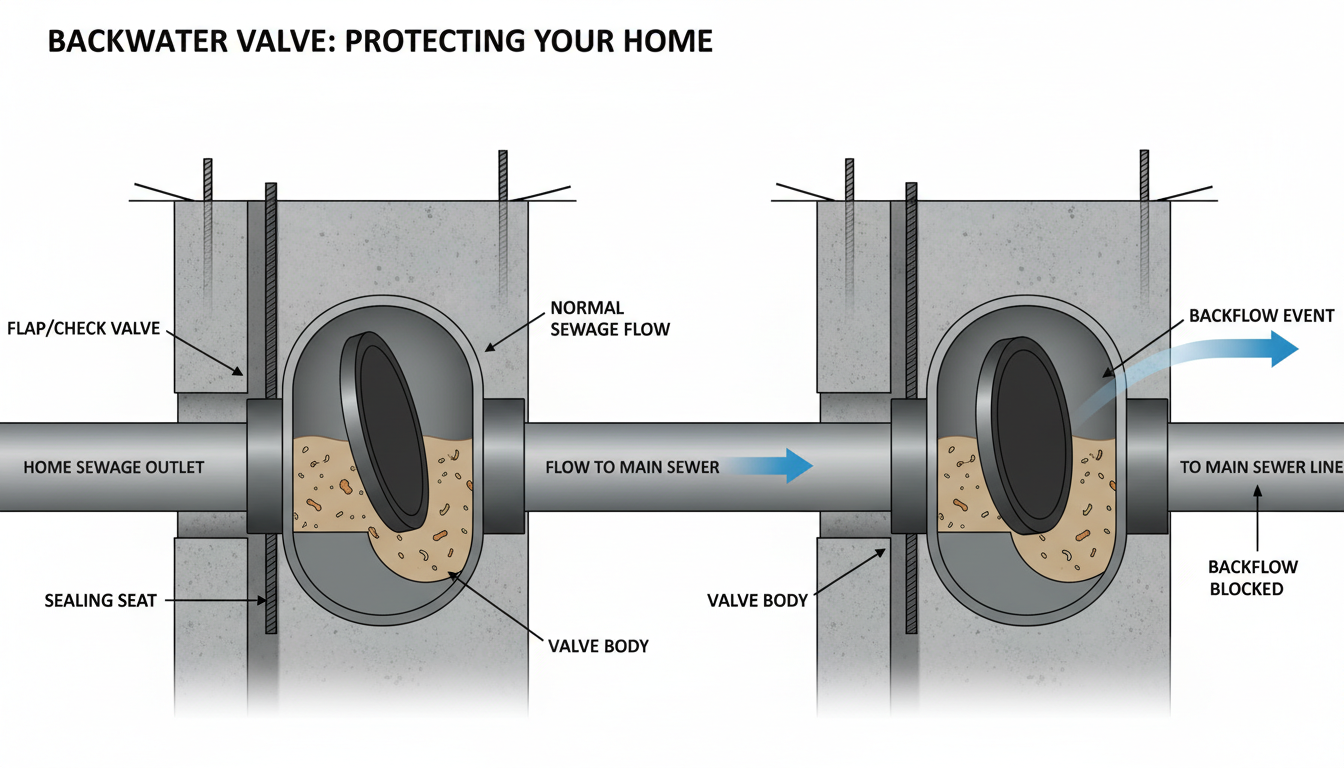
How a backwater valve works — a one-way flap that prevents sewage from flowing backwards into your home.
The Ontario Building Code requires backwater valves on all new construction. For existing homes, it's not mandatory — but your insurance company might have a different opinion. Many insurers now require a backwater valve before they'll cover sewer backup damage, and installation typically costs $2,000–$4,000 versus $20,000–$50,000+ for a sewage flood cleanup.
Sewage backing up into your basement is one of the worst things that can happen to a home. It's not just water — it's raw sewage, carrying bacteria, viruses, and contaminants that make the affected space uninhabitable until professionally remediated. The smell alone can linger for months. And the damage to flooring, drywall, furniture, and personal belongings adds up fast.
A backwater valve is one of the simplest and most effective ways to prevent this nightmare. Yet most existing homes in North Bay don't have one. Here's everything you need to know about what they are, whether you're required to have one, and why it's one of the smartest investments you can make as a homeowner.
What Is a Backwater Valve?
A backwater valve is a one-way flap valve installed on your home's main sewer lateral — the pipe that connects your house to the municipal sewer system. It sits in the floor of your basement, typically near the floor drain or where the main sewer line exits the foundation.
The concept is simple. Under normal conditions, wastewater flows one direction — out of your home and into the municipal sewer. The backwater valve's flap stays open, allowing normal drainage. But when the municipal sewer becomes overwhelmed and pressure builds in the opposite direction, the flap swings closed. Sewage can't push past the valve and into your home. It's a mechanical barrier between your basement and the city's sewer system.
Think of it like a door that only swings one way. Water can leave your house freely, but nothing can come back in. When the municipal system returns to normal pressure, the flap opens again and regular drainage resumes. No electricity required, no sensors, no moving parts beyond the flap itself.
There are two main types. A normally open backwater valve keeps the flap open during regular use and only closes when backflow pressure is detected — this is the most common type for residential installations. A normally closed backwater valve (also called a backflow preventer) keeps the flap closed and only opens when water flows out of the house. Your plumber will recommend the right type based on your home's plumbing configuration and local requirements.
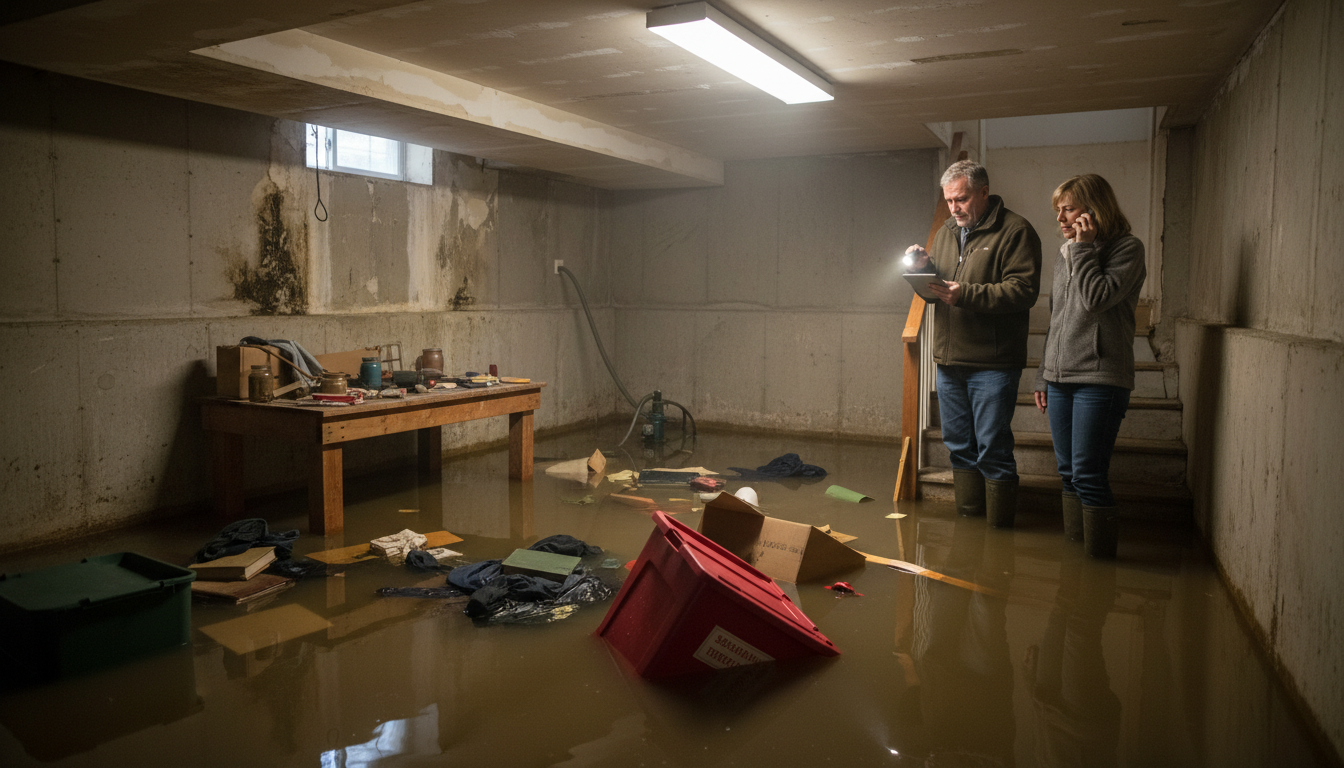
A sewage-flooded basement — the kind of damage a $3,000 backwater valve installation prevents.
Is It Required in Ontario?
For new construction: yes. The Ontario Building Code (OBC), specifically Section 7.4.6, requires backwater valves on all new residential construction. If your home was built in the last 15–20 years, there's a good chance one was installed during construction. If you're building a new home in North Bay, your plumber is required to install one before the rough-in inspection passes.
For existing homes: not retroactively required — but increasingly expected. The OBC does not require homeowners to retrofit a backwater valve into an existing home. There's no bylaw in North Bay that forces you to install one. However, the practical reality has shifted significantly in recent years, and the "not required" status is increasingly irrelevant for two reasons.
First, insurance companies are driving the change. A growing number of Ontario insurers now require a backwater valve as a condition of sewer backup coverage. If you don't have one and you file a sewer backup claim, your insurer may deny the claim entirely — even if you've been paying for sewer backup coverage on your policy. We'll cover this in detail in the insurance section below.
Second, some Ontario municipalities offer rebate programs that cover a significant portion of the installation cost. While North Bay doesn't currently have a dedicated backwater valve rebate program, municipalities like Toronto, Ottawa, and Burlington offer rebates of $1,250–$3,400. It's worth checking with the City of North Bay periodically, as these programs are becoming more common across Ontario as municipalities deal with aging infrastructure and increased storm events.
Quick Summary: Ontario Backwater Valve Requirements
- New construction (OBC 7.4.6): Mandatory. Must be installed during construction.
- Existing homes: Not retroactively required by code or municipal bylaw in North Bay.
- Insurance: Increasingly required for sewer backup coverage. Check your policy.
- Rebates: Available in some Ontario municipalities. Check with your local city hall.
- Our recommendation: Every North Bay home with a basement should have one, regardless of code requirements.
Why North Bay Homeowners Need One
The code may not require it for existing homes, but North Bay's geography, infrastructure, and climate make backwater valves especially important here. Several factors combine to create elevated risk for sewer backup in our area.
Spring melt overwhelms the municipal sewer system. North Bay gets an average of 200+ centimetres of snowfall each winter. When that snow melts — often rapidly during warm spells in March and April — the volume of water entering the storm and sanitary sewer systems can exceed their capacity. When municipal sewers surcharge (meaning the water level in the sewer rises above the pipe crown), the excess pressure pushes sewage backwards through the path of least resistance — and that path often leads to your basement floor drain.
Older combined sewer systems in West Ferris and Downtown. Some of North Bay's older neighbourhoods — particularly West Ferris, Downtown, and parts of the south end — still have combined sewer systems where stormwater and sanitary sewage share the same pipes. During heavy rain or rapid snowmelt, these combined systems get overwhelmed far more easily than separated systems. If you live in one of these areas, your risk of sewer backup is significantly higher.
Heavy rain events are increasing in frequency. Climate data shows that intense rainfall events — the kind that dump 50+ millimetres in a few hours — are becoming more common across Northern Ontario. These sudden deluges can surcharge even modern separated sewer systems. The City of North Bay's infrastructure was designed for historical rainfall patterns, not the increasingly intense storms we're seeing today.
Sewer surcharges don't discriminate. You don't need to live in a flood-prone area to experience sewer backup. A surcharge event in the municipal main can push sewage backwards into any connected home — uphill, downhill, it doesn't matter. The only thing that stops it is a physical barrier at your property line or inside your home. That barrier is a backwater valve.

Reviewing your insurance policy for sewer backup coverage requirements — many Ontario insurers now require a backwater valve.
The Insurance Angle
This is where the backwater valve conversation gets very practical very fast. Forget the building code for a moment — your insurance policy might be the most compelling reason to install one.
Many Ontario insurers now require backwater valves for sewer backup coverage. Sewer backup claims have skyrocketed across Ontario over the past decade. In response, insurers have tightened their requirements. Some won't offer sewer backup coverage at all without a backwater valve. Others will offer coverage but with significantly higher deductibles — sometimes $10,000 or more — if you don't have one installed.
Installation can reduce your premiums by 10–20%. Many insurance companies offer premium discounts for homes with backwater valves, sump pumps, and other flood prevention measures. The exact discount varies by insurer, but 10–20% on the water damage portion of your premium is common. Over several years, this premium reduction can offset a significant portion of the installation cost.
The math on damage prevention is overwhelming. A typical sewage backup in a finished basement results in $5,000–$50,000+ in damage. That includes professional remediation (required — you can't DIY sewage cleanup safely), flooring replacement, drywall removal and replacement, furniture loss, and temporary accommodation costs if the home is uninhabitable during restoration. Compare that to a one-time backwater valve installation cost of $2,000–$4,000. The valve pays for itself the moment it prevents a single backup event.
Action Step: Call Your Insurance Company
Before you do anything else, call your home insurance provider and ask these three questions:
- Does my policy include sewer backup coverage?
- Is a backwater valve required for that coverage to apply?
- Will installing a backwater valve reduce my premium?
The answers will tell you exactly how urgent this is for your specific situation.
What Installation Involves
Installing a backwater valve is a straightforward job for a licensed plumber, though it does involve some concrete work. Here's what the process looks like from start to finish.
Step 1: Locate and expose the main sewer lateral. Your main sewer line exits your home through the basement floor, typically near the front of the house. The plumber identifies the exact location and marks the cut area on the basement floor.
Step 2: Cut the basement floor. A section of concrete floor — usually about 2 feet by 3 feet — is cut and removed using a concrete saw. This exposes the main sewer pipe below the slab. This is the messiest part of the job, but an experienced crew contains the dust with plastic sheeting and a vacuum system.
Step 3: Install the valve. The plumber cuts into the sewer lateral and installs the backwater valve inline. The valve housing sits flush with the finished floor level so you can access the cleanout cap for future maintenance. All connections are sealed and tested for watertightness.
Step 4: Restore the concrete. The excavated area is backfilled, compacted, and the concrete floor is patched. A good crew will match the patch to the existing floor as closely as possible. The valve's access cover remains visible and accessible at floor level.
Step 5: Inspection and testing. The valve is tested to confirm the flap operates correctly — opening freely for outgoing flow and sealing tight against backflow pressure. In North Bay, a plumbing permit may be required depending on the scope of work. Your plumber handles this.
Timeline: Most residential backwater valve installations are completed in a single day. You'll be without main sewer drainage for 4–6 hours during the installation. Plan accordingly — no laundry, showers, or flushing during that window.
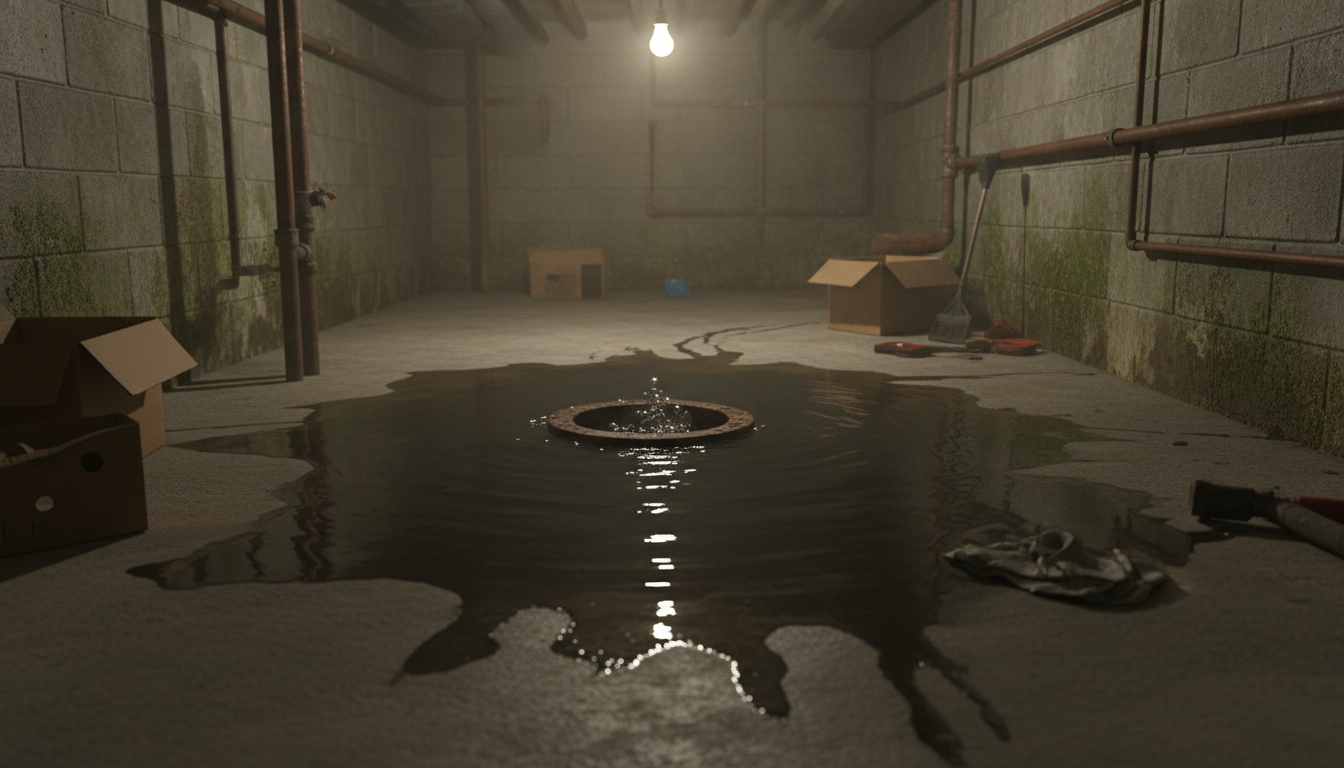
Sewage backing up through a basement floor drain — the exact scenario a backwater valve is designed to prevent.
Cost vs Risk
Let's put the numbers side by side so there's no ambiguity about the value proposition.
Backwater valve installation: $2,000–$4,000. This is a one-time cost that includes the valve, concrete cutting and restoration, labour, and materials. The price varies depending on accessibility, depth of the sewer lateral, and the complexity of your specific plumbing configuration. Most North Bay homes fall in the $2,500–$3,500 range.
Sewage flood cleanup and restoration: $20,000–$50,000+. A sewage backup in a finished basement typically costs $20,000–$50,000 to fully remediate and restore. This includes professional hazmat-level cleanup (required by Ontario regulations for Category 3 water damage), removal and replacement of all affected drywall and insulation to at least 2 feet above the water line, flooring replacement, dehumidification, and antimicrobial treatment. If the backup is severe or goes unnoticed for hours, costs can exceed $50,000.
That's not counting what insurance doesn't cover. Personal belongings, family photos, irreplaceable items stored in the basement — insurance pays depreciated value at best, and many items have no replacement value. Then there's the 2–6 weeks of disruption while your basement is being restored. And the lingering smell that can permeate the entire house.
The bottom line: A backwater valve costs roughly 10–15% of what a single sewage backup event would cost. It lasts 20+ years with minimal maintenance. There are very few home improvements with a more compelling cost-benefit ratio. Combined with a properly functioning sump pump and basement waterproofing, a backwater valve is a critical component of a complete basement protection system.
Maintenance
A backwater valve is a low-maintenance device, but it does need periodic attention to ensure it works when you need it. Neglecting maintenance is the most common reason backwater valves fail during an actual surcharge event.
Annual inspection. Once a year — ideally in early spring before the melt season — open the access cover on the valve and visually inspect the flap. It should move freely on its hinge, with no debris, grease buildup, or corrosion preventing full closure. This takes about 5 minutes and requires no tools beyond removing the access cap.
Keep it clean. Over time, grease, soap residue, and small debris can accumulate on the valve flap and seat. If you notice buildup during your annual inspection, clean the flap and seating surface with warm water and a mild detergent. Avoid harsh chemicals that could degrade the rubber seal.
Test the flap movement. During your inspection, manually move the flap through its full range of motion. It should swing closed easily under light pressure and return to the open position smoothly. If the flap sticks, binds, or doesn't seat properly when closed, have a plumber service the valve before the next rain or melt event.
Watch for warning signs. Slow basement floor drains, gurgling sounds from the floor drain during heavy rain, or sewer odours coming from the valve access point are all signs that the valve may need attention. Don't ignore these — they often indicate the flap is partially stuck or debris is interfering with normal operation.
Professional servicing. If your valve is more than 10 years old, or if you've never had it inspected by a professional, schedule a sewer line inspection that includes a backwater valve check. A plumber can camera-inspect the valve and the surrounding sewer lateral to confirm everything is functioning correctly and identify any developing issues before they become problems.
Ready to Protect Your Basement?
Whether you need a backwater valve installed, an existing valve inspected, or a complete basement protection assessment, we're here to help. One call gets it handled.
Call 705-482-1253